

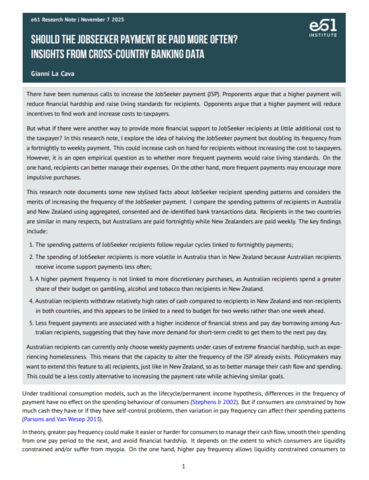
Briefing paper
Should the JobSeeker payment be paid more often?
This paper explores the idea of halving the JobSeeker payment but doubling its frequency from a fortnightly to weekly payment. The paper documents JobSeeker recipient spending patterns and finds they face more financial stress, experience greater spending volatility and withdraw higher rates of cash than New Zealand recipients who receive weekly payments.
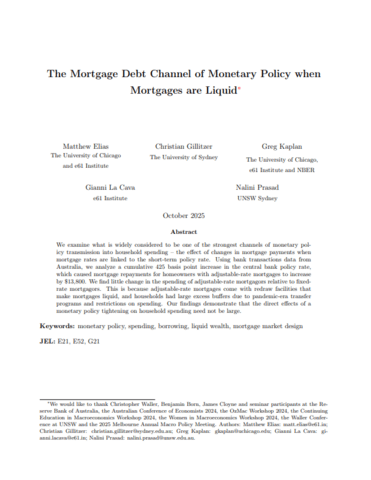
Working paper
The mortgage debt channel of monetary policy when mortgages are liquid
Australians hold some of the highest levels of mortgage debt in the world. This paper examines what is widely considered to be one of the strongest channels of monetary policy transmission into household spending – the effect of changes in mortgage payments when mortgage rates are linked to the short-term policy rate.

Briefing paper
Cost of living crisis relief: insights from the COVID-19 financial support policies
This paper examines how two major policies responding to the COVID-19 pandemic affected the wellbeing of eligible recipients, one that increased liquidity by releasing personal savings and one that increased wealth through a government transfer. The findings suggest the former raised life satisfaction while the latter did not.
Report
The lucky country or the lucky city? The location of economic opportunity in Australia
This report follows the trajectories of workers of different occupations, ages, and locations to better understand how wages and housing costs vary between the cities and regions. It also identifies the migration flows within Australia occurring in response to changing locations of opportunity finding overseas immigration has offset the worker exodus from the cities
Submission
Five facts from the COVID-19 economic supports
During the COVID-19 pandemic, the Commonwealth Government provided a range of financial support measures to alleviate the adverse economic consequences faced by individuals and businesses, and stimulate economic activity. The authors analyse the effectiveness of four support measures. By understanding the effectiveness of these measures, governments can be ready to respond to future economic downturns...