

Working paper
 SHARE
SHARE
The mortgage debt channel of monetary policy when mortgages are liquid
Publisher
Assets
Mortgages
Monetary policy
Interest rates
Household finance
Australia

Description
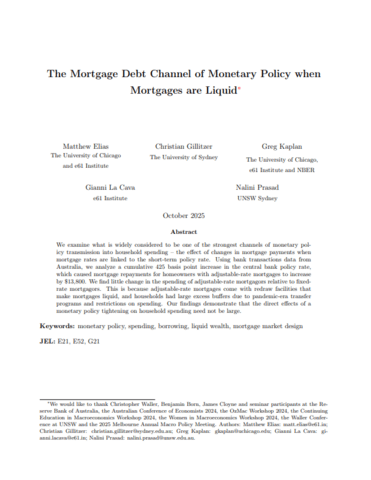
Australians hold some of the highest levels of mortgage debt in the world, and most borrow at variable rates that adjust almost immediately when policy rates change. This working paper examines what is widely considered to be one of the strongest channels of monetary policy transmission into household spending – the effect of changes in mortgage payments when mortgage rates are linked to the short-term policy rate.
The paper uses aggregated, consented and deidentified bank transactions data to compare households with variable-rate and fixed-rate mortgages during the 2022–23 monetary policy tightening cycle.
The findings demonstrate that the direct effects of a monetary policy tightening on household spending need not be large.
Key findings
- Despite facing much higher repayments (around $14,000 over 18 months) variable-rate borrowers did not cut their spending relative to fixed-rate borrowers.
- Around 70% of the increase in repayments was met by drawing down on pandemic-era savings in offset and redraw accounts.
- These buffers have blunted the usual cash flow effects of monetary policy. The resilience that cushioned borrowers from rate hikes may now also dull the boost from rate cuts.
- Australia’s flexible mortgage system – with its redraw and offset accounts – is unique internationally, and these ‘hidden shock absorbers’ can reshape how and when monetary policy affects the economy.
Publication Details
Copyright:
The authors 2025
Access Rights Type:
open
Post date:
6 Nov 2025
