

Briefing paper
Same amount, different tax: capital income tax calculator
There is a perception that individuals who earn capital income pay much lower tax rates than wage and salary earners. This note explains the complexity of capital taxation using examples from a new online tax calculator. It shows three illustrative situations in which capital income can be either under- or over-taxed relative to labour income.
Briefing paper
Housing leverage and the capital gains tax discount
This note on the capital gains tax (CGT) discount focuses on leverage distortions by investigating data on housing investments. By examining the individual rental income and capital gains returns for 900,000 housing investments held over 2008 to 2025, the note demonstrates how and why the CGT discount encourages investors to borrow more than they otherwise...
Report
Work, welfare and wellbeing around entry into the NDIS
The National Disability Insurance Scheme (NDIS) is one of Australia’s largest social programs, yet questions remain about how it affects participants’ employment, reliance on other welfare payments, and overall wellbeing. Understanding these relationships is essential for assessing the scheme’s long-term sustainability and its role in supporting participation and independence.
Briefing paper
Everyone is different: the problem with a flat capital gains tax discount
One objective of Australia’s capital gains tax (CGT) discount is to approximate inflation and tax real gains. But because real returns vary widely across investors, a flat discount systematically misses the mark. Using data on 1.5 million property investments (2008–2025), this paper shows real returns range from losses to strong gains.
Briefing paper
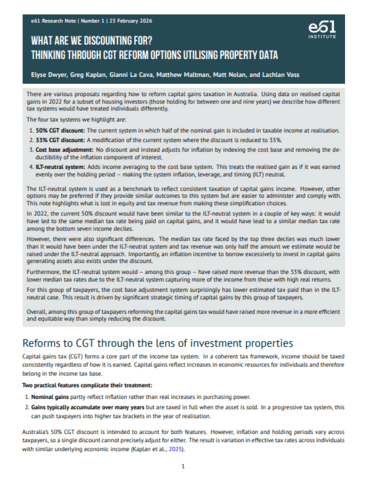
What are we discounting for? Thinking through CGT reform options utilising property data
There are various proposals regarding how to reform capital gains taxation in Australia. Using data on realised capital gains in 2022 for a subset of housing investors (those holding for between one and nine years) this paper describes how four different tax systems, including the current system, would have treated individuals differently.