

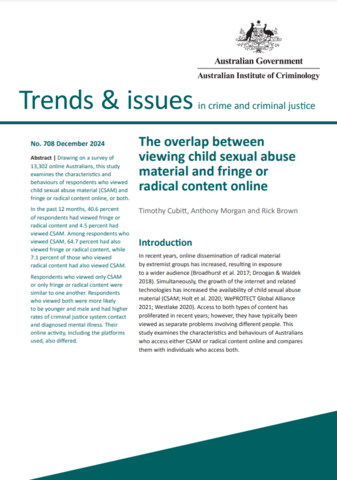
Briefing paper
The overlap between viewing child sexual abuse material and fringe or radical content online
This examination of the characteristics and behaviours of Australians who access either child sexual abuse material or radical content online finds that individuals who access both are a distinct group, demographically and behaviourally. The findings highlight the need for content moderation policies that consider the overlap between different types of harmful content and target both...
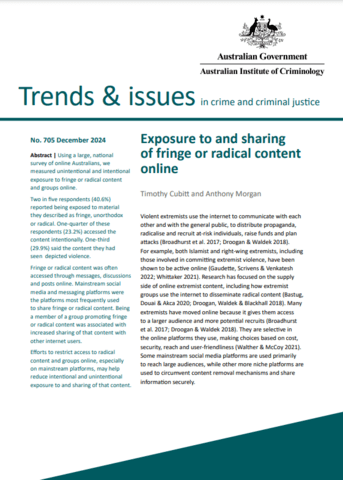
Briefing paper
Exposure to and sharing of fringe or radical content online
The research aimed to understand the prevalence of online exposure to fringe or radical content in Australia, the motivations behind accessing such content, and the platforms facilitating its spread. It finds a significant number of people are unintentionally exposed to this material, highlighting the importance of removing it from online platforms.
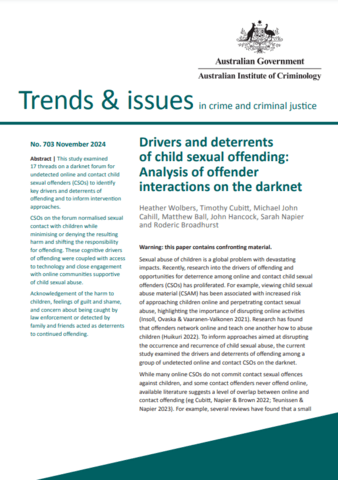
Briefing paper
Drivers and deterrents of child sexual offending: analysis of offender interactions on the darknet
This study seeks to understand the drivers and deterrents of child sexual offending by analysing posts on a darknet forum frequented by self-identified paedophiles. The findings highlight the role of technology in avoiding detection, and the authors call on law enforcement to disrupt technology-mediated discussion among offenders.

Briefing paper
An experimental study of support for protest causes and tactics and the influence of conspiratorial beliefs
A study of community attitudes towards protest in Australia, focusing on the influence of protest tactics and the interaction with belief in conspiracy theories. The study found that support for protest was influenced by both the cause and the tactics used, with peaceful protests significantly more supported than disruptive or violent protests.

Discussion paper
Targeting fixated individuals to prevent intimate partner homicide
Intimate partner homicide (IPH) is one of the most common forms of homicide in Australia. Considerable recent public debate has focused on the issue yet relatively few programs have been designed to prevent it. This paper explores whether and how a multi-agency model designed to intervene with fixated individual could be applied to the problem.