

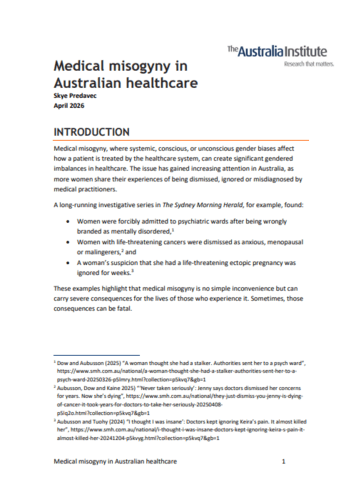
Briefing paper
Medical misogyny in Australian healthcare
Medical misogyny, where systemic, conscious or unconscious gender biases affect how a patient is treated by the healthcare system, can create significant gendered imbalances in healthcare. This paper outlines some causes of medical misogyny and investigates its practical impacts on Australians. Addressing the crisis of medical misogyny requires structural change to Australian healthcare.
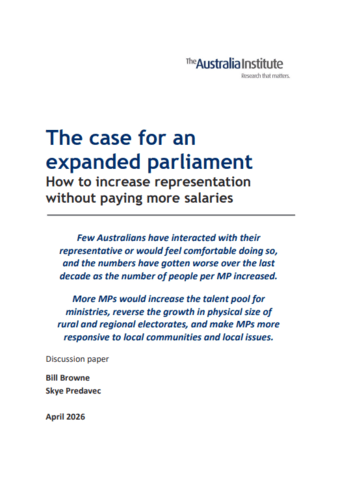
Discussion paper
The case for an expanded parliament
Australia’s democracy is being stretched thin, with each federal parliamentarian MP now representing almost four times as many people as at Federation. This paper proposes that more MPs would increase the talent pool for ministries, reverse the growth in physical size of rural and regional electorates, and make MPs more responsive to local communities.
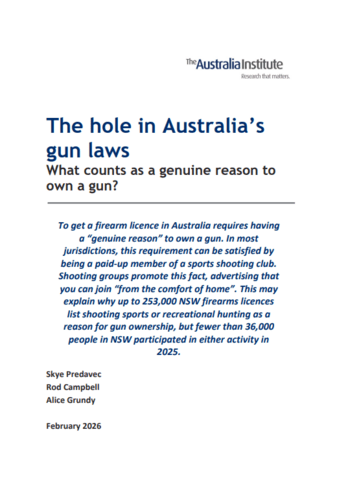
Briefing paper
The hole in Australia’s gun laws
Acquiring a firearm licence in Australia requires having a 'genuine reason' to own a gun. In most jurisdictions, this requirement can be satisfied by being a paid-up member of a sports shooting club. This paper finds that the thin practical requirements for obtaining a firearm licence are allowing an erosion of Australia’s gun control regime.
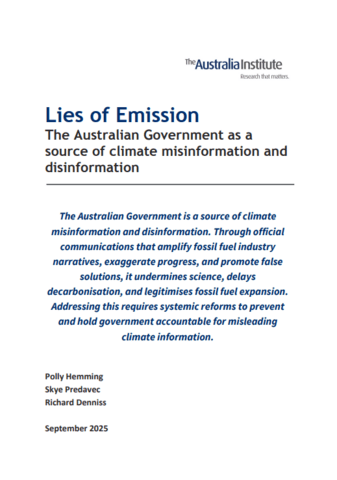
Report
Lies of emission: the Australian Government as a source of climate misinformation and disinformation
Climate misinformation and disinformation in Australia often originates from the very institutions charged with protecting the public interest. This report finds that the Australian Government is a source of climate misinformation and disinformation. While the report focuses on climate, the reforms outlined address the same root causes that enable misinformation across Australian public life.
Discussion paper
Australia’s private high school problem: unequal, expensive and falling behind
Australia has one of the world’s most privatised high school systems. This paper reveals that Australia is the most expensive place in the developed world for families to send a child to high school. It finds there is no evidence that the significant expense of privatised school education has boosted Australia’s education performance.