

Culturally and Linguistically Diverse (CALD)
Alternative labels
Culturally and linguistically diverse
Non-English speaking background
NESB
Report
Culturally and Linguistically Diverse (CALD) women in prison: pre-prison experiences and post-release reintegration
This research examines pre-prison experiences and post-release needs for the reintegration of CALD women in NSW prisons back into society. It also seeks to create an increased understanding of the needs of CALD women prisoners and to provide information for prison and stakeholders providing social services.
Report
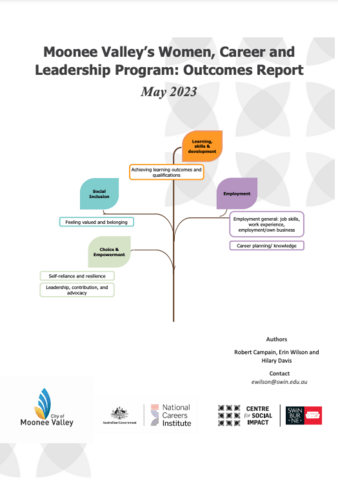
Moonee Valley’s Women, Career and Leadership Program: outcomes report
The Women, Careers and Leadership (WCL) Program offered women from migrant and refugee backgrounds living in the Housing Estates opportunities to further develop and pursue their career goals through a range of workshops and programs, along with ongoing mentoring support. The responses to the survey are overwhelmingly positive which may suggest that people have been...

Research Summary
"When you find people like you, you don't have to explain yourself": experiences of social connection in outer-metropolitan suburbs
This project focuses on finding new evidence and using it to assist community partners and policy-makers to activate social connection in practical ways. It looks particularly at outer-metropolitan suburbs with diverse populations and ongoing rapid growth.

Report
Care criminalisation of children with disability in child protection systems
The Royal Commission into Violence, Abuse, Neglect and Exploitation of People with Disability commissioned this research to improve understanding of the pathways that lead children with disability from their contact with child protection system to entering the criminal justice system.
Report
Sense of belonging among multilingual audiences in Australia
This report focuses on how the news media can play a role in driving a sense of belonging among multilingual audiences. The aim is to better understand the relationship between multilingual audiences’ sense of belonging, their participation in Australian society, and perceptions of trust and representation in the news.