

Person
Erin Wilson
ORCID:
Report
Down Syndrome Australia, Employment Connections Service
This report assesses Down Syndrome Australia’s Employment Connections Service, which provides tailored, evidence-aligned employment services to jobseekers with Down syndrome and employers. It concludes the model that best reflects evidence on ''what works” for this cohort is not well matched to the way mainstream funding is currently structured.
Journal article
Supporting employment transitions for people with intellectual disabilities
Disability Enterprises have the potential to address employment barriers that people with an intellectual disability experience as they move into open employment through strategic organisational design. This report explores how well organisations align with best practice models and the ongoing challenges they face in supporting open employment pathways for people with a disability.
Evaluation
Evaluation of the White Box Enterprises Evolve Program
The Evolve program aims to transition three (former) Australian Disability Enterprises (ADEs) into jobs-focused social enterprises through consulting and funding. To date, this Australian pilot program has highlighted the tensions between establishing viable business models alongside a focus on social purpose.
Report
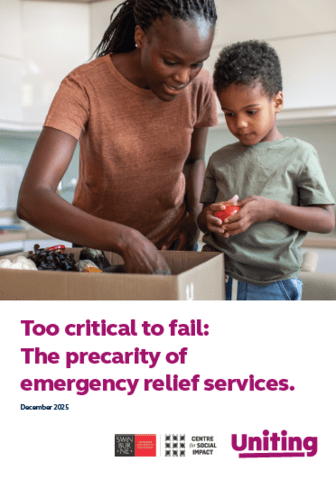
Too critical to fail: the precarity of emergency relief services
Despite being a critical service that provides immediate food relief and other essential items to those in acute need, emergency relief services are themselves experiencing precarity. To better understand this precarity of and the factors underpinning it, this research was conducted through a study into eight Uniting emergency relief services in Victoria and Tasmania.
Report
The state of the social economy in Australia
A world where economies are measured by the extent to which they generate positive social and environmental outcomes is being shaped around the globe by the social economy. This first comprehensive research into Australia’s social economy explores key areas including funding, partnerships, impact measurement, legal and policy frameworks, and digital technologies.