

Co-design
Alternative labels
Coproduction
Co-creation
Journal article
The co-design of an Indigenous and community-led culturally responsive prevention framework to reduce the incarceration of children
This study addresses the disproportionate incarceration of Aboriginal and Torres Strait Islander children in Australia by co-designing an Indigenous community-led, culturally responsive prevention framework. The resulting framework comprises three interconnected levels: universal outcomes for thriving children, connected families and empowered communities, rights-based systemic reforms, and culturally grounded program elements across the life course.
Report
Youth Voice engagement report
This report documents a national co-design process to establish a strong, culturally grounded and community-led Youth Voice initiative for Aboriginal and Torres Strait Islander young people. Participants said existing systems too often engage young people in tokenistic or advisory-only ways, without genuine power-sharing or accountability.
Evaluation
Evaluation of NDIS Alternative Commissioning Pilots in remote and First Nations communities
The aim of the NDIS Alternative Commissioning Pilots in remote and First Nations communities was to co-design, implement and evaluate place-based, community-driven alternative commissioning models in partnership with communities. This report contains the findings of the evaluation to support the future development and scaling up of alternative commissioning. It makes 10 overall recommendations.
Report
What's important to us in health research? Establishing national health research priorities through a co-design process
This report describes a co-design process, involving interviews and art-based research, to find out what health issues matter most to people with intellectual disability in Australia. The findings are intended to help guide which health research topics should be prioritised in the future.
Case study
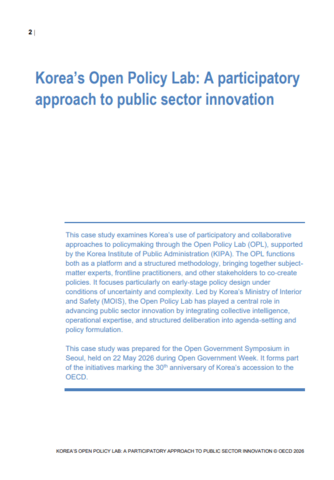
Korea’s Open Policy Lab: a participatory approach to public sector innovation
This case study examines Korea’s use of participatory and collaborative approaches to policymaking through the Open Policy Lab (OPL). The OPL functions both as a platform and a structured methodology, bringing together subject-matter experts, frontline practitioners and other stakeholders to co‑create policies. It focuses particularly on early‑stage policy design under conditions of uncertainty and complexity.