

Evidence-based practice
Report
Learning lessons: the future of small-group tutoring
Despite initially being envisaged as a temporary program in response to COVID-19 pandemic school closures, small-group tutoring has attracted a great deal of attention from various policymakers as a potential solution to Australia’s student achievement problem. However, while the appeal of small-group tutoring as a permanent feature of Australian education is understandable, policymakers should carefully...
Article
The right data at the right time in the right hands supports better outcomes
This article outlines some of the key problems with the current approach to data use and describes how Restacking the Odds (RSTO) has been addressing these problems. RSTO provides a framework of evidence-based lead indicators, resources and tools to support service providers (including frontline practitioners), and policymakers to improve service quality, quantity and participation across...
Report
Sharpening teacher tools: creating an evidence-based standard for quality instructional materials
High-Quality Instructional Materials (HQIM) are defined as educational resources that effectively support student learning by aligning with curriculum standards and applying evidence-based teaching and learning approaches. This paper examines insights from international policy examples for curriculum-aligned HQIM.
Report
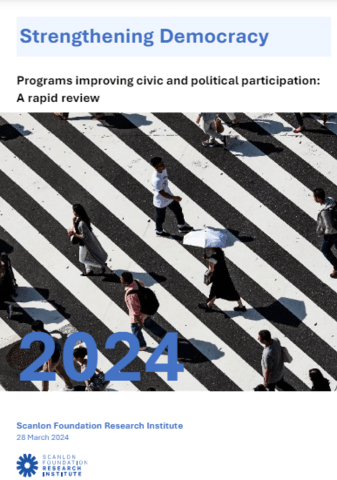
Programs improving civic and political participation: a rapid review
This report presents findings of a rapid review of evaluations of programs that aim to improve civic and political participation carried out in the United States of America, Canada, the United Kingdom, Member States of the European Union and the European Free Trade Agreement, Australia and New Zealand.
Position paper
Advice to governments: evidence-informed and good practice psychosocial services
This paper outlines a diverse cross-section of psychosocial services shown to be effective and valued by people with lived experience of mental ill-health, family, carers and supporters. The advice in this paper also shows the principles which should underpin the design of any future psychosocial services.