

Parenting and guardianship
Alternative labels
Parenting skills
Report
National review: work conditions and discrimination among pregnant and parent workers in Australia
This review was undertaken to convey the prevalence of work-related discrimination, disadvantage and bias, in relation to pregnant and parent workers in Australia.
Report
Video visitation in Australian prisons: perspectives on father–child contact
This paper presents the findings from the first multi-jurisdictional study to explore the experiences and impacts of video visits between fathers in prison and their children. Findings show that there are significant benefits to video visitation for fathers, children and children’s carers, and corrective services.

Report
Analysis of linked longitudinal administrative data on child protection involvement for NSW families with domestic and family violence, alcohol and other drug issues and mental health issues
There has long been consensus that domestic and family violence, parental mental health issues and alcohol and other drug use are strongly interlinked and increase the risk of children and young people entering out-of-home care. This study observes those interconnections, and is one of the first external projects to use the newly established NSW Human...
Report
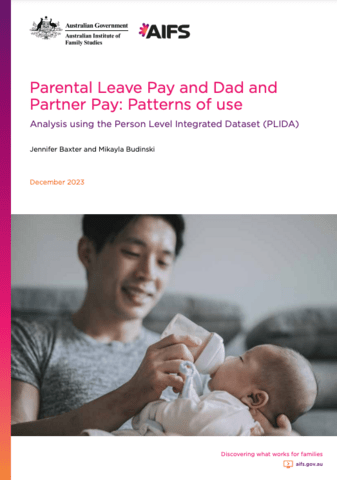
Parental Leave Pay and Dad and Partner Pay: patterns of use
This report presents findings from the ‘Statistical profile of use of Paid Parental Leave and Dad and Partner Pay’ project that uses the Multi Agency Data Integration Project (MADIP), now referred to as the Person Level Integrated Data Asset (PLIDA).
Research Summary
Intimate partner violence among Australian 18–19 year olds
This snapshot examines risk and protective factors for intimate partner violence victimisation among Australian adolescents. The aim is to help policy-makers and service providers to identify populations that could be at increased risk, so that protective factors can be strengthened.