

Digital transformation
Alternative labels
Digitisation
Report
Digitising the social safety net: lessons from Indonesia
The digitisation of social safety nets can help drive inclusion and reduce poverty while fostering more resilient social and economic development. Indonesia’s experience offers important lessons for other countries in how to do so through policy focus and careful design.
Journal article
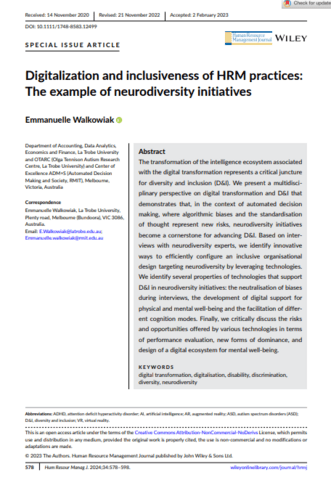
Digitalization and inclusiveness of HRM practices: the example of neurodiversity initiatives
This paper presents a multidisciplinary perspective on digital transformation and D&I that demonstrates, in the context of automated decision making, where algorithmic biases and the standardisation of thought represent new risks, neurodiversity initiatives become a cornerstone for advancing D&I. It identifies innovative ways to efficiently configure an inclusive organisational design targeting neurodiversity by leveraging technologies.
Submission
Submission to the Inquiry into the Digital Transformation of Workplaces
The House of Representatives Standing Committee on Employment, Education and Training inquiring into the rapid development and uptake of automated decision-making and machine learning techniques in the workplace. This submission takes a bigger picture perspective of technological change within organisations that rises above these current concerns.
Submission
Submission to the Inquiry into the Digital Transformation for Workplaces
This paper argues that decisions made regarding the deployment of Generative AI technology in workplaces will fundamentally change how we work, produce, create and collaborate, and that it is time to act to ensure a safe, inclusive and productive technology deployment.
Book
Artificial intelligence and the challenge for global governance: nine essays on achieving responsible AI
Artificial intelligence (AI) is creating novel challenges for governance. Technical advances and widening use of AI have increased concerns about the risks of such technology, while also underscoring its transformational potential. This collection of nine essays explores pathways towards responsible AI, and proposes both broad principles and specific ideas for future-proof AI governance.