

Health practitioners
Alternative labels
Medical professionals
Health care professionals
Medical practitioners
Medical personnel
Health care workers
Health workers
Report
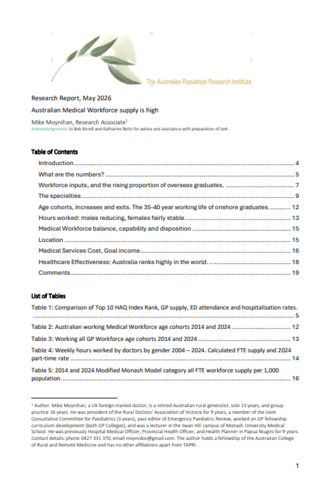
Australia’s medical workforce supply is high
Assertions that the Australian working medical workforce supply is low are common. However, this report finds that Australia’s supply per 1,000 of the population is nearly the highest in the OECD. The report proposes that the challenge for Australia is to shift acute medical care into the community and downsize hospitals.

Report
Whole of medical workforce supply and demand compendium report
The study presents long-term projections of supply and demand for medical practitioners. The key challenge with the Australian medical workforce is that, while estimates suggest that there may be enough medical practitioners, they are not optimally distributed across specialties, sectors, settings and locations to meet the needs of the Australian community.

Journal article
Designing mentorship for constrained systems
Mentorship is widely recognised as a valuable strategy for supporting health professionals. This article examines how mentorship can be designed for constrained health systems, including in rural and remote settings. It proposes a systems-oriented perspective that positions mentorship as part of routine practice rather than as a separate professional development activity.
Briefing paper
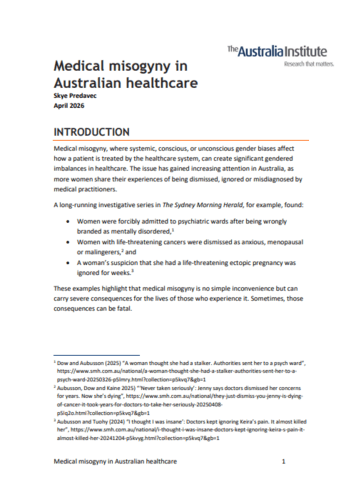
Medical misogyny in Australian healthcare
Medical misogyny, where systemic, conscious or unconscious gender biases affect how a patient is treated by the healthcare system, can create significant gendered imbalances in healthcare. This paper outlines some causes of medical misogyny and investigates its practical impacts on Australians. Addressing the crisis of medical misogyny requires structural change to Australian healthcare.

Report
Psychology Supply and Demand compendium report
The Psychology Supply and Demand Study is a health workforce model that projects the supply and demand of Australia's psychologists over a 15-year period from 2024 to 2038. The workforce is projected to grow by 34% over the next 15 years. However, demand projections for psychologists indicate a persistent workforce shortage throughout this period.