

Primary health care
Guide
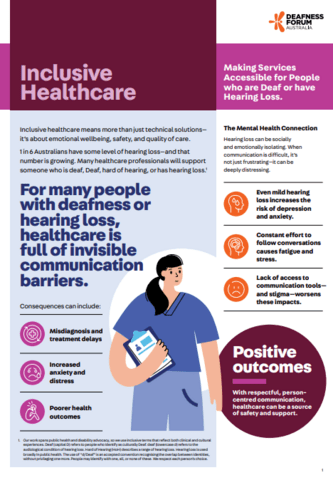
Inclusive healthcare: making services accessible for people who are deaf or have hearing loss
A practical guide designed to help healthcare providers deliver respectful, person-centred care to people who are Deaf, deaf, hard of hearing, or have hearing loss. It explores how communication barriers in healthcare can lead to misdiagnosis, distress, and poorer outcomes and offers simple and effective strategies.
Report
Final report: the implementation of recommendations relating to cross-jurisdictional health reform and government consultation with remote, rural and regional communities
This report examines cross-jurisdictional health reform, collaboration and government consultation with remote, rural and regional communities in New South Wales. It finds that rural and remote primary care is in crisis and proposes a pathway forward to facilitate reform. The report presents 12 findings and 18 recommendations.
Journal article
Urgent care centres for reducing the demand on emergency departments
A scoping review of studies examining the impact of urgent care centres (UCCs) on the numbers of presentations to emergency departments (EDs), their costs, and the experiences of patients and practitioners. It concludes that UCCs can help reduce the number of ED presentations. However, continuity of care was a concern for both clinicians and patients.
Report
Special Commission of Inquiry into Healthcare Funding
A final report of a holistic review into the funding of health services in New South Wales (NSW) examines its governance structure, how funds are delivered and strategies to address escalating costs. It finds that the NSW health system is a good one, however it has its failings. It provides 41 recommendations across 12 priority...
Journal article
Remote health: what are the problems and what can we do about them?
This article analyses three broad questions: how is ‘remote’ different from ‘rural’; how do these differences affect the provision of health care and health outcomes, positively and negatively; and what is needed to address these issues and systematise solutions in order to deliver parity of health outcomes. It finds the distinguishing characteristics of remote areas...