

Remote health

Discussion paper
Abortion access in South Australia
This report analysed publicly available data from South Australia and found that 18% of the population who might need abortion care live in country areas but under 3% of abortions are coordinated in country-based health services. The report recommends changes to improve access to abortion care in country South Australia.
Journal article
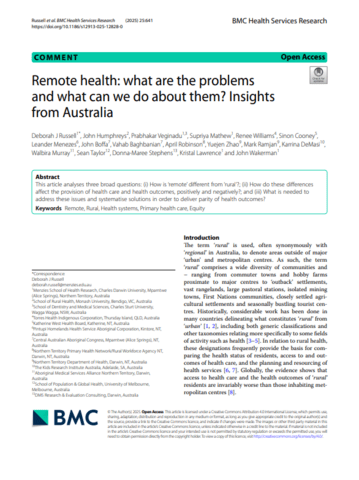
Remote health: what are the problems and what can we do about them?
This article analyses three broad questions: how is ‘remote’ different from ‘rural’; how do these differences affect the provision of health care and health outcomes, positively and negatively; and what is needed to address these issues and systematise solutions in order to deliver parity of health outcomes. It finds the distinguishing characteristics of remote areas...
Report
Report 2: the implementation of recommendations relating to the delivery of specific health services and specialist care in remote, rural and regional NSW
Access to timely, affordable and high quality specialist care is critical to improving the health outcomes of remote, rural and regional (RRR) communities. This report examines the progress and challenges in the delivery of various specific health services and specialist care in RRR New South Wales. It presents 24 findings and 32 recommendations.
Journal article
Which way? Experiences of Aboriginal and Torres Strait Islander people who are deaf or hard of hearing attaining supports
This paper argues the National Disability Insurance Scheme must enhance collaboration with participants, local communities and Aboriginal Community Controlled Organisations, disability service providers, and the wider health system, to develop more locally led solutions that empower Aboriginal and Torres Strait Islander Deaf or Hard of Hearing participants to achieve better outcomes.
Report
Working Better for Medicare review
This review examined the effectiveness of current health workforce distribution levers. These levers are laws, policies and classifications that encourage or require health professionals to work in areas of workforce shortage. The review finds current levers are not sufficient to the task and makes 26 recommendations to update them.