

Artificial Intelligence (AI)
Alternative labels
Generative AI (GenAI)
Report
International AI safety report
This report brings together 100 experts on artificial intelligence (AI) to create a shared international understanding of risks from advanced AI and how they can be mitigated. It finds a wide range of trajectories for the future of general-purpose AI are possible, and much will depend on how societies and governments act.
Guide
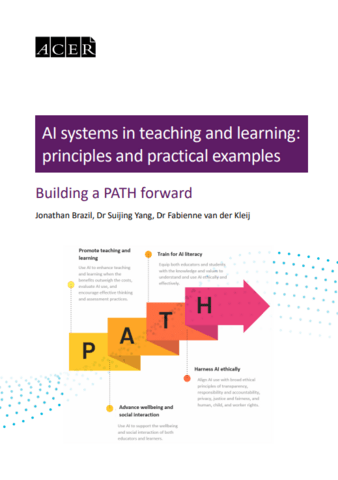
AI systems in teaching and learning: principles and practical examples
The rapid popularisation of artificial intelligence (AI) systems signifies a major shift in teaching and learning, bringing both new opportunities and significant challenges. This document provides guiding principles and practical examples for using AI in teaching and learning, underpinned by a human-centred approach. The guidance is applicable in a range of international contexts and school...
Literature review
Artificial intelligence and child sexual abuse
This study describes the state of current research at the intersection of artificial intelligence (AI) and child sexual abuse (CSA). It examines the uses of AI for the prevention and disruption of CSA, and the ways in which AI is used in CSA offending. An evidence gap map is provided to guide future research.
Briefing paper
Free and fair: election law in the age of AI
This briefing paper explores the impact of AI-enabled disinformation and fake content on democratic processes and investigates the potential obligations of states to protect elections from it. The paper argues that although not currently legally bound to do so, states should take proactive measures to defend elections from AI misuse.
Submission
Submission to the Attorney-General Department consultation paper on ADM reform
This submission argues that a more comprehensive regulatory framework for automated decision-making (ADM) in the public sector is required. It calls for a framework that goes beyond existing administrative law, is not limited to AI-based systems and includes measures for prevention, enforcement and accountability.