

Machine learning
Alternative labels
Neural network modelling
Artificial neural networks
Deep learning
Large language model (LLM)
Report
AI openness: a primer for policymakers
This paper explores openness in artificial intelligence (AI), including relevant terminology and how different degrees of openness can exist. There is ongoing debate about the risks, benefits and trade-offs of making AI models publicly available. This paper seeks to support policy discussions on how to balance the openness of generative AI foundation models with responsible...

Report
Artificial intelligence in healthcare
Over the past decade, artificial intelligence (AI) has gained significant momentum in healthcare. This report outlines its potential, ethical considerations, existing laws and the international response to AI in healthcare. It maintains the final decision on patient care should always be made by a human. The report calls on the government to make certain obligations...
Evaluation
Evaluation of translation ability of language models for education-related communication
The project aimed to assist the NSW Department of Education in achieving multilingual communication within educational settings through the deployment of Large Language Models (LLMs). This report describes the findings which shed light on the expected performance of current LLMs for the specific use case of the department and provide a methodology for similar evaluations.

Report
Financial risk indicators of child sexual abuse live streaming: a proof of concept prediction model
The live streaming of child sexual abuse (CSA) is a technologically and financially enabled crime type which has proliferated in recent years. This study uses a machine learning approach to produce a proof-of-concept model for identifying financial indicators associated with CSA live streaming. It reveals an important opportunity to use financial transactions to detect and...
Report
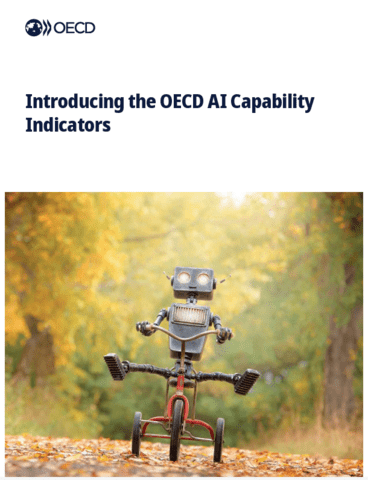
Introducing the OECD AI Capability Indicators
This report introduces the OECD’s beta AI Capability Indicators, designed to assess and compare AI advancements against human abilities. The indicators cover nine human abilities: language, social interaction, problem solving, creativity, metacognition and critical thinking, knowledge, learning and memory, vision, manipulation and robotic intelligence. They provide a framework for policymakers to understand AI's potential impacts.