

Income
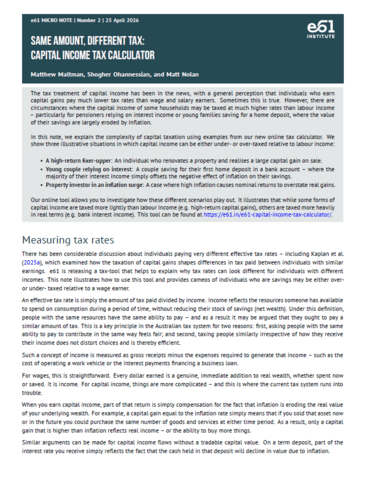
Briefing paper
Same amount, different tax: capital income tax calculator
There is a perception that individuals who earn capital income pay much lower tax rates than wage and salary earners. This note explains the complexity of capital taxation using examples from a new online tax calculator. It shows three illustrative situations in which capital income can be either under- or over-taxed relative to labour income.
Report
Pathways to economic mobility and improved equity
The Vocational Education and Training (VET) National Data Asset release and report provides statistical insights on domestic, non-school students that completed a nationally recognised VET qualification in the 2020–21 financial year. The analysis explores the economic, employment and further study outcomes of VET graduates. It highlights the positive economic and employment gains for VET graduates.
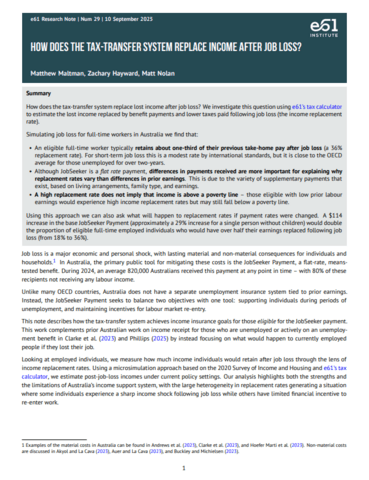
Report
How does the tax-transfer system replace income after job loss?
This paper investigates how the tax-transfer system replaces lost income after job loss. It uses e61’s tax calculator to estimate the lost income replaced by benefit payments and lower taxes paid following job loss (the income replacement rate). The paper also explores what will happen to replacement rates if payment rates were changed.

Report
New mothers, employment and income
Mothers’ employment rates in Australia have increased over recent decades but having a child is still a pivotal event. This report explores some of the diversity in the employment patterns of new mothers. The findings further build the evidence base on mothers’ employment and could be used to inform policy in a range of areas.
Briefing paper
Six more measures of Australia’s declining living standards
The paper presents data on six measures of living standards: mortgage stress, disposable income, the number of Australians with more than one job, household price levels, tax burden and debt burden. It finds that price level rises in various household goods and services all exceeded wages growth between 2022 and 2024.