

Health data
Alternative labels
Health care data
Report
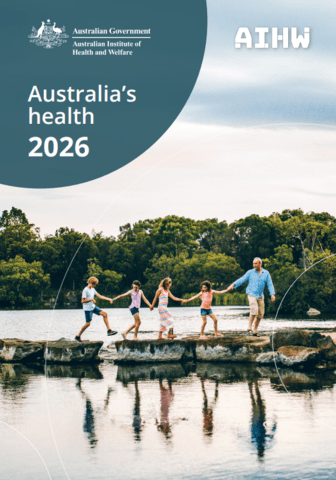
Australia's health 2026
The report presents the latest key findings and a selection of short topic-based narratives, offering insights into contemporary health and wellbeing issues in Australia. It charts the nations’ progress while also informing priorities for future improvement. It finds that 3 in 5 Australians live with at least one chronic condition.
Strategy
National suicide prevention outcomes framework: data quality framework
This document describes what the framework is, why it is important for the National suicide prevention outcomes framework and who is responsible for using it. The Data quality framework is a systematic approach to defining, assessing and improving the quality of data relevant to the outcomes framework.
Working paper
Socioeconomic inequalities in birth weight
This study uses population-wide birth registration data linked to census records to examine the relationship between socioeconomic factors and the birth weight of Australian children. The findings suggest policies aimed at improving socioeconomic conditions may contribute to better early-life health outcomes by reducing the risk of low birth weight.
Strategy
2026 – 2036 National health and medical research strategy
The strategy sets out a 10-year vision for strengthening Australia’s health and medical research system. Its scope encompasses all elements of health and medical research across the Commonwealth, states and territories, industry, academia, health professionals, consumers, community and philanthropy. The strategy sets out the vision, goals and focus areas.

Discussion paper
Artificial intelligence and evidence-informed policy – emerging challenges and opportunities: discussion paper
This discussion paper examines the intersection of artificial intelligence (AI) and evidence-informed policymaking, outlining how AI can support problem identification, policy design and implementation. It emphasises that AI augments rather than replaces human judgement, while highlighting its potential to expand the evidence base and support more timely, responsive decision-making in complex health contexts.