

Capital gains tax
Assessment
Capital gains tax and negative gearing
This Impact Analysis Equivalent considers reforms to negative gearing and capital gains tax arrangements. It sets out the problem being addressed, the proposal, the assessment outcome and the regulatory burden. The Department of the Treasury estimates the changes would increase average regulatory costs by $88.4 million per year.

Briefing paper
Tax Green Paper series. Part 1: CGT and negative gearing
Capital gains tax (CGT) and negative gearing were two of the top three priorities for tax reform in Australia identified by participants at a community tax summit. This paper argues for a reduction to the CGT discount from 50% to 25% and limiting negative gearing deductions to investment income only.
Briefing paper
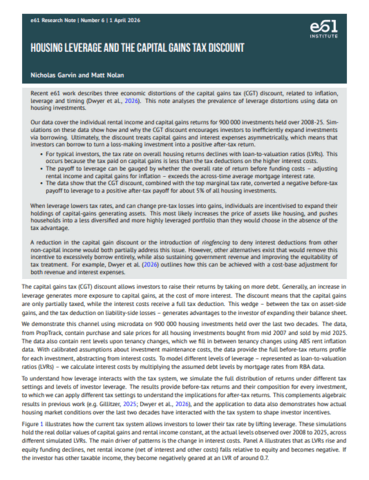
Housing leverage and the capital gains tax discount
This note on the capital gains tax (CGT) discount focuses on leverage distortions by investigating data on housing investments. By examining the individual rental income and capital gains returns for 900,000 housing investments held over 2008 to 2025, the note demonstrates how and why the CGT discount encourages investors to borrow more than they otherwise...
Discussion paper
Discount or penalty? How high inflation turns the capital gains discount into a hidden tax on investment
The role of inflation in determining the merits of different forms of capital gains taxation is widely misunderstood. This paper finds the discount is not always more generous than the previous system and can produce very high effective rates of taxation on real capital gains because taxation is levied on both real and inflationary gains.
Briefing paper
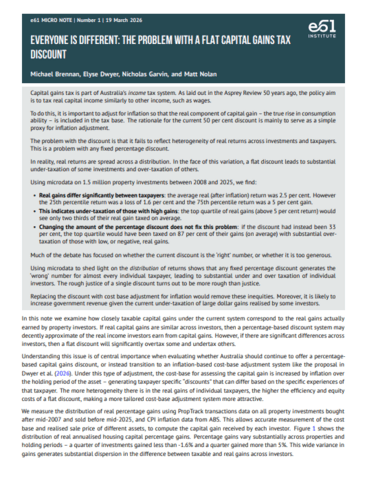
Everyone is different: the problem with a flat capital gains tax discount
One objective of Australia’s capital gains tax (CGT) discount is to approximate inflation and tax real gains. But because real returns vary widely across investors, a flat discount systematically misses the mark. Using data on 1.5 million property investments (2008–2025), this paper shows real returns range from losses to strong gains.