

Democratic reform
Report
Unscrambling government: less confusion, more efficiency
New Zealand has one of the most complex systems of executive government in the developed world – with 81 ministerial portfolios, 28 ministers and 43 departments. This report concludes this proliferation undermines effective government. It argues that reform is essential for greater accountability, faster decision-making and stronger fiscal discipline.
Discussion paper
Advantages of incumbency: MP and senator entitlements in 2025
Australian federal Members of Parliament and Senators are entitled to over $3 million in pay, resources and benefits over a three-year election cycle. These resources can be used to boost re-election chances. Combined with changes to electoral laws coming into force, this paper finds that these threaten to make Australian elections less competitive than ever.
Report
Upgrading democracy: a new deal to repair the broken relationship between citizen and state
This paper sets out the challenge of the new global democratic emergency and how this is threatening the political landscape in Britain. It makes the case to upgrade democracy by rebuilding the relationship between state and citizen, in order to win back trust and secure a better democratic future.
Report
DOGE done better: the case for progressive efficiency and a streamlined state
This paper sets out a progressive alternative to DOGE, the US Department of Government Efficiency. It makes the case for a department organised around intelligence, linking multiple tiers of government, and a movement. The paper suggests what is to be done, how it should be done, what principles should be used, and what structures work...
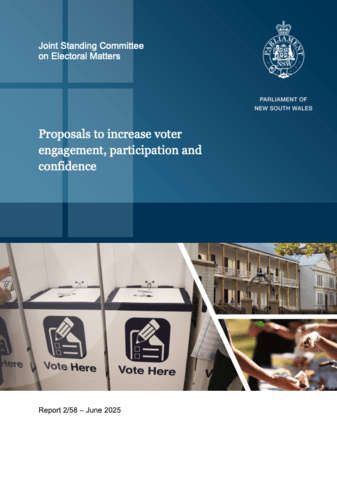
Report
Proposals to increase voter engagement, participation and confidence
A report from an inquiry into proposals to increase voter engagement, participation and confidence in New South Wales. It presents three findings and provides 22 recommendations. The recommendations cover a variety of matters ranging from civics education, voting information, technology-assisted voting and electoral funding laws.