

Election campaign funding
Alternative labels
Campaign finance
Discussion paper
Electoral Reform Bill analysis
Proposed changes to Australian electoral law would make elections less fair and substantially more expensive, according to this analysis of the Electoral Reform Bill. This paper finds that the Bill, which includes measures such as capping political spending and increasing transparency around donations, would disproportionately benefit established parties.
Briefing paper
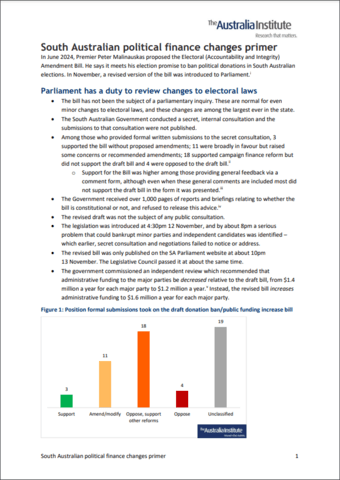
South Australian political finance changes primer
This primer responds to South Australia's proposed Electoral (Accountability and Integrity) Amendment Bill, concerning political donations and public funding of political parties. It argues that while the Bill claims to ban donations, it introduces several loopholes and ultimately increases public funding significantly, disproportionately benefiting major parties.
Submission
Money and power in South Australian elections: the effects of a donation ban on competitive elections
The proposed increase in public funding and restrictions on donations for South Australian elections would unfairly favour major parties and incumbents at the expense of competitive elections. A democracy voucher model of public funding would better meet the stated objectives behind the change, while also providing for fairer elections and empowering South Australian voters.

Report
Shining a light: improving transparency in New Zealand’s political and governance systems
According to this report, low levels of corruption are part of New Zealand’s self-identity. The report considers the growing perception of corruption in New Zealand’s political and governance systems in recent years and why this matters.
Discussion paper
Securing transparency and diversity in political finance
The authors of this paper argue that targeted reforms are needed to introduce transparency and diversity into federal political finance: disclosing political contributions in real time, publishing ministers’ diaries, stopping the very wealthy from dominating election spending, making public funding accessible to new entrants and restricting corporate cash-for-access payments.