

Evidence-based policy
Alternative labels
Evidence-informed policy
Journal article
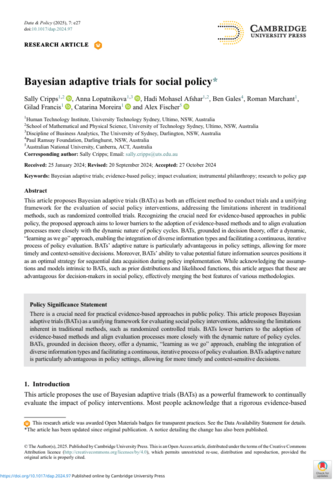
Bayesian adaptive trials for social policy
There is a crucial need for practical evidence-based approaches in public policy. This article proposes Bayesian adaptive trials as an efficient method to conduct trials and as a unifying framework for the evaluation of social policy interventions. This approach addresses limitations inherent in traditional methods and recognises the need for evidence-based approaches in public policy.
Guide
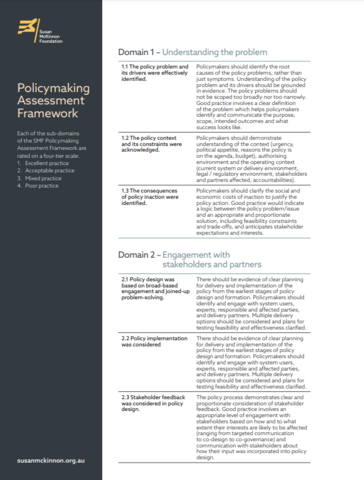
Policymaking assessment framework
This assessment tool supports the measurement of the quality of policymaking processes – both existing and planned – across sectors. It provides a flexible framework for rating public policy processes using information available in the public domain. The framework's objective is to simplify the path towards best practice, evidence-informed policy.

Report
Everybody cares about using education research sometimes
This report explores the role of knowledge intermediaries in the field of education. It draws on a survey of 288 organisations across 34 countries to examine how these organisations facilitate the use of research in policy and practice. The report identifies gaps in skills and infrastructure and emphasises the need for better co-ordination and evaluation.
Report
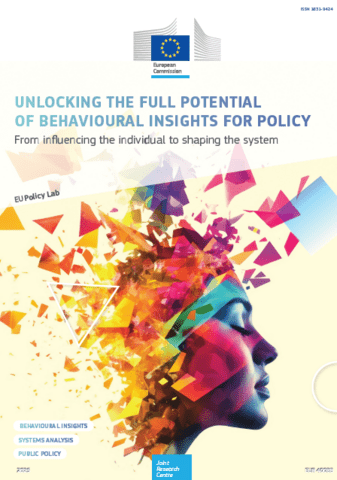
Unlocking the full potential of behavioural insights for policy
This report examines the transformative role of behavioural insights (BI) in European Union policymaking, advocating for integrating BI early in the policy cycle to enhance policy effectiveness. The policy relevance of this work lies in its timely contribution to evidence-based approaches, particularly in areas where the human dimension is key to policy success.
Guide
OECD recommendation on public policy evaluation: implementation toolkit
The toolkit offers practical guidance for government officials and evaluators seeking to improve their evaluation capacities and systems, by enabling a deeper understanding of their strengths and weaknesses and learning from OECD member country experiences and trends. It supports the practical implementation of the principles contained in the 2022 OECD recommendation on public policy evaluation.