

Evidence-based policy
Alternative labels
Evidence-informed policy
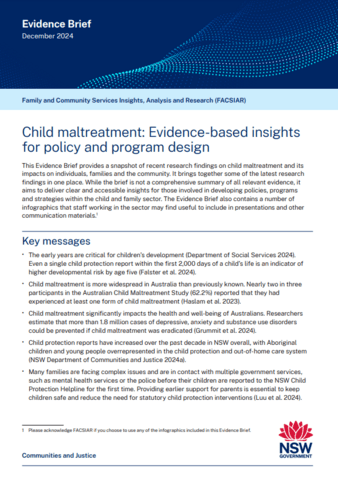
Briefing paper
Child maltreatment: evidence-based insights for policy and program design
This Evidence Brief provides a snapshot of recent research findings on child maltreatment and its impacts on individuals, families and the community. While the brief is not a comprehensive summary of all relevant evidence, it aims to deliver clear and accessible insights for those involved in developing policies, programs and strategies within the child and...
Case study
Victoria State Government’s Early Intervention Investment Framework
The Victorian Government introduced the Early Intervention Investment Framework in 2021 with the aim to guide early intervention policy and budget proposals that focus to improve lives of inhabitants by linking government’s funding to quantifiable impacts. This case study gives an overview of the framework which provides a basis for trialling innovative early intervention initiatives.
Guide
Eyes on evidence: best practices toolkit
This toolkit offers guidance, tools and best practices to improve the transparent use of evidence in policymaking. It also contains solutions to pursue on how government systems, structures and resources can implement evidence-informed and transparent policy-making to its fullest potential.

Strategy
Victorian suicide prevention and response strategy 2024-2034
A 10-year strategy that builds a systems-based, evidence-informed, whole-of-government and community-wide approach to suicide prevention and response. The strategy aims to reduce the rate of suicide, support those impacted and stop the stigma that surrounds it by working across government, service providers and the community to deliver objectives under 6 priority areas.
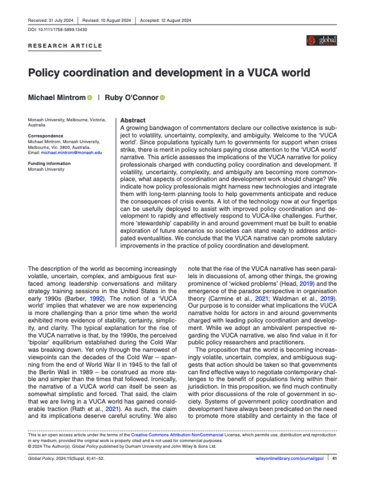
Journal article
Policy coordination and development in a VUCA world
This article assesses the implications of the volatility, uncertainty, complexity and ambiguity (VUCA) narrative for policy professionals and in particular, what aspects of coordination and development work should change. The authors argue that by harnessing new technologies and integrating them with long-term planning tools, policymakers can help governments anticipate and reduce the consequences of crisis...