

Briefing paper
 SHARE
SHARE
Child maltreatment: evidence-based insights for policy and program design
Publisher
Evidence-based policy
Prevention
Child protection
Vulnerable children
First Peoples child protection
Family services
Early intervention services
Child abuse
Australia
New South Wales
Resources
| Attachment | Size |
|---|---|
 Child maltreatment: evidence-based insights for policy and program design Child maltreatment: evidence-based insights for policy and program design
|
1.14 MB |
Description
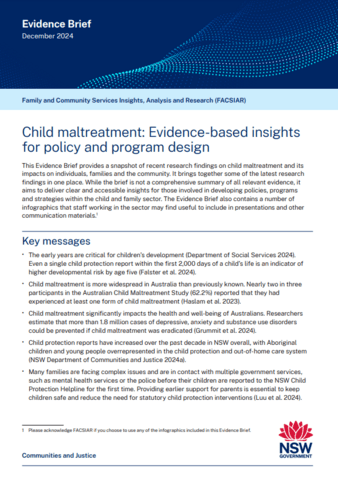
This Evidence Brief provides a snapshot of recent research findings on child maltreatment and its impacts on individuals, families and the community.
While the brief is not a comprehensive summary of all relevant evidence, it aims to deliver clear and accessible insights for those involved in developing policies, programs and strategies within the child and family sector.
The Evidence Brief also contains a number of infographics that staff working in the sector may find useful to include in presentations and other communication materials.
Key messages
- The early years are critical for children’s development. Even a single child protection report within the first 2,000 days of a child’s life is an indicator of higher developmental risk by age five.
- Child maltreatment is more widespread in Australia than previously known.
- Child maltreatment significantly impacts the health and well-being of Australians.
- Child protection reports have increased over the past decade in NSW overall, with Aboriginal children and young people overrepresented in the child protection and out-of-home care system
- Many families are facing complex issues and are in contact with multiple government services, such as mental health services or the police before their children are reported to the NSW Child Protection Helpline for the first time.
- Leaving families with multiple risk factors unsupported leads to significant human and government costs.
- The underlying causes of child maltreatment are complex, multidimensional and often overlapping.
- Timely access to quality universal services along with targeted support for families with higher needs can transform a child’s entire life, shifting their path from poor educational performance and disadvantage to educational success and career opportunities
- Addressing child maltreatment requires a coordinated, cross-government approach focused on early intervention and prevention.
Publication Details
Copyright:
State of New South Wales 2025
Access Rights Type:
open
Post date:
20 Jan 2025
