

Material deprivation
Report
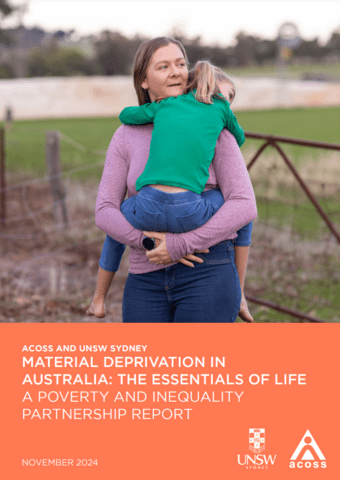
Material deprivation in Australia: the essentials of life
People are in poverty when they lack the resources necessary to live within socially acceptable living standards. This report identifies 23 essential items considered universally as things nobody should have to go without, and measured how many people lack these items because they cannot afford them. The results highlight the impact of economic hardship on...
Report
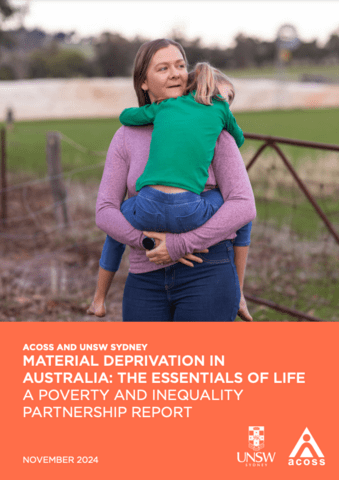
Material deprivation in Australia: the essentials of life
Contributing to the evidence base on furthering an understanding of the Australian experience of poverty, this report aims to guide the development of targeted and effective poverty alleviation, advocacy and policy. It finds that specific groups are particularly at high risk of multiple deprivation, namely: people relying on JobSeeker Payment; Parenting Payment, Disability Support Pension...
Briefing paper
Entrenched disadvantage in Western Australia: health, economic and social impacts
100 Families WA is a collaborative research project aimed at understanding the lived experience of poverty, entrenched disadvantage and social exclusion. The first bulletin focuses on the health, economic and social impacts of hardship experienced by families in Perth, Western Australia.
Report
Material deprivation and social exclusion among young Australians: a child-focused approach
This report is the first of its kind to apply the deprivation approach to examine deprivation among young Australians using information provided by young people themselves. It builds on earlier projects that developed and applied the approach used here to adults.
Report
The material wellbeing of New Zealand households: trends and relativities using non-income measures, with international comparisons
This report uses non-income measures (NIMs) to examine material wellbeing of New Zealand households. NIMs focus on living conditions in terms of food, clothing, accommodation, heating, and transport, and in terms of their ability to maintain or replace broken household appliances, purchase desirable non-essentials, cope with unexpected demands on the household budget, and so on.