

Water security
Alternative labels
Water sustainability

Guide
Indo-Pacific explainer: critical infrastructure
From power grids and water systems to transportation networks and digital communications, critical infrastructure forms the backbone of society and economy. This explainer explores what makes infrastructure 'critical', threats and why safeguarding it has become a top priority for governments, businesses and communities. The guide identifies critical infrastructure sectors in Australia.
Position paper
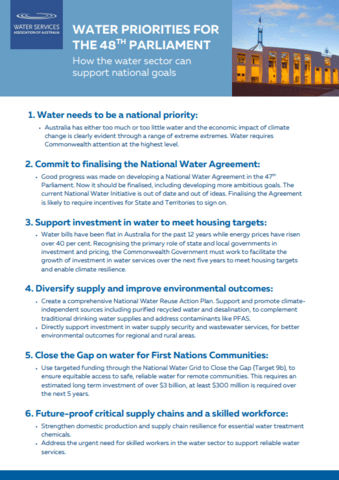
Water priorities for the 48th Parliament
Australia has either too much or too little water. This paper provides eight water priorities for the 48th parliament. It calls on the Australian federal government to finalise the National Water Agreement, to be bolder with water management and unify the states and local governments to sustain and manage Australia’s water into the future.
Discussion paper
Big thirsty Australia
This discussion paper argues that assumptions of future water abundance are dangerously flawed. It presents original data analysis of Australia's water use over the past four decades, and summarises recent studies of the impacts of climate change on water availability. The paper reviews recent urban water demand and population projections and examines the costs and...

Report
Glencore’s proposed carbon capture and storage project
This inquiry was established to consider the proposed Surat Basin Carbon Capture and Storage (CCS) Project by the Carbon Transport and Storage Corporation, which is a wholly owned subsidiary of Glencore. A key recommendation from the inquiry is that states and territories consider a legislated ban on CCS activities across the Great Artesian Basin to...
Report
National Water Reform 2024: inquiry report
The final inquiry report sets out the Productivity Commission’s findings and recommendations on the urgent need to renew the 2004 National Water Initiative, due to climate change and changing water demand. The report also sets out the Commission’s assessment of jurisdictions’ progress towards meeting the outcomes and objectives of the 2004 National Water Initiative.