

Report
Report
Beyond patchwork reform: a new institutional architecture for the National Electricity Market
According to this report, the National Electricity Market (NEM) – the system which connects more than 80% of Australians to one electricity grid – needs a fundamental overhaul. The original design of the NEM assumed that private markets and price signals could not only guide investment, but also accommodate changing environmental requirements. The analysis makes...
Report
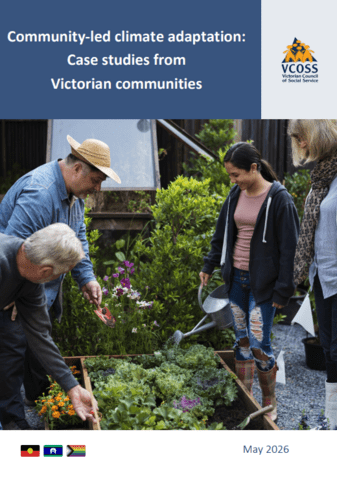
Community-led climate adaptation
Adapting to the impacts of climate change is a social and economic imperative. This report explores some models the community sector in Victoria already has in place for this vital capacity- and resilience-building work. Adaptation to climate change will not work unless it addresses the needs of the most imperilled groups.
Report
Effectiveness of the Commonwealth Home Support Program
The Commonwealth Home Support Program (CHSP) has provided entry‑level aged care services to people in their homes to assist them to live safely and independently. This audit examined the effectiveness of the CHSP. The audit found the CHSP is partly effective. It provides recommendations to improve planning, monitoring, stakeholder engagement, assurance, performance measurement and evaluation.
Report
Towards a financially inclusive higher education system
This report examined the prevalence and impact of financial hardship on Australian university students. It evaluated the effectiveness of existing financial support services and identified barriers that prevent students from accessing essential assistance. It recommends that government funded payment schemes be enhanced, and that universities should expand and enhance their emergency and non-monetary support services.

Report
Free TAFE
This report evaluates Victoria's Free TAFE initiative introduced in 2019. It finds that while the program successfully boosted training participation in priority skill areas and provided substantial tuition fee savings to students, it resulted in higher per-enrolment government costs and failed to significantly shift the overall proportion of priority student cohorts.