

First Peoples
Aboriginal and Torres Strait Islander peoples should be aware that this resource may contain images or names of people who have since passed away.
 SHARE
SHARE
The health and wellbeing of First Nations people in Australia’s prisons 2022
| Attachment | Size |
|---|---|
 The health and wellbeing of First Nations people in Australia’s prisons 2022 The health and wellbeing of First Nations people in Australia’s prisons 2022
|
609.84 KB |
Aboriginal and Torres Strait Islander people are recognised as the oldest continuous cultures on earth (Commonwealth of Australia 2017). First Nations people have a holistic concept of health and wellbeing, which is recognised and supported in government policies and services.
It is important to understand how the past shapes the lives of First Nations Australians today - they have a long history of trauma, cultural dispossession, and forced displacement and assimilation, which affects their physical, mental and social wellbeing.
First Nations people make up a small proportion (3.8%) of the Australian population. Yet they are over-represented in the prison
system, making up 32% of the total prison population, and are incarcerated at much higher rates than non-Indigenous Australians. In addition to complex health and wellbeing needs, First Nations people in prison may also require access to culturally-safe health care services.
Key findings:
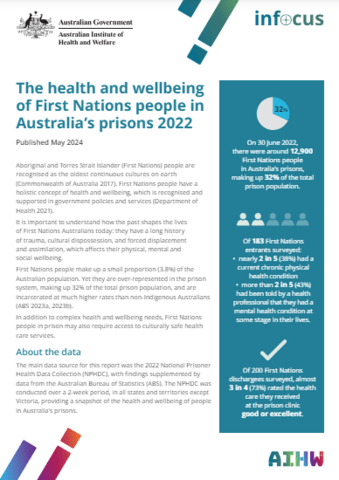
- On 30 June 2022, around 12,900 First Nations people were in Australia’s prisons, making up 32% of the prison population.
- More than 2 in 5 (43%) First Nations prison entrants surveyed had a history of a mental health condition.
- Almost 3 in 4 (73%) First Nations prison dischargees surveyed rated the health care received in prison good or excellent.
