

 SHARE
SHARE
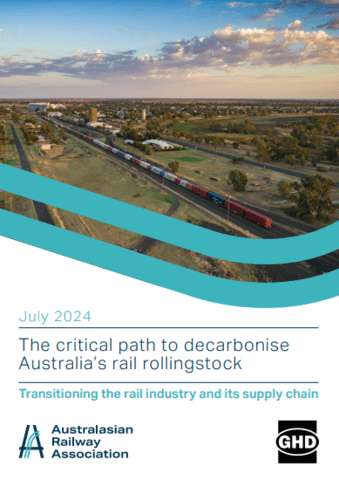
The critical path to decarbonise Australia’s rail rollingstock

The Australian rail industry is at a critical juncture on its journey towards decarbonisation. In the next eight to 13 years, about half of the industry’s rollingstock is expected to be replaced. For this next generation of rollingstock to embrace low and zero emissions technologies, urgent action is needed to develop clear pathways for a decarbonised rail network.
This report seeks to identify the key challenges associated with decarbonising rail operations and provide government, industry and other stakeholders with a shared understanding of the actions needed to progress the decarbonisation of rail operations nationally, and the supply chain challenges and capabilities that will need to be addressed to support the transition.
The report was informed by desktop analysis, collaboration with the ARA Rollingstock Decarbonisation and Heavy Haul Decarbonisation Working Groups and engagement with key government and industry stakeholders.
The report sets out the actions needed to support the availability, uptake and implementation of low and zero emission technologies to address traction emissions related to diesel-powered locomotives which continue to be used for regional passenger, freight and heavy haul rail operations. National and state net zero strategies and plans generally promote the use of low-emissions transport options, supported by renewable energy targets and strategies and funding for research and development. The role of rail to support the decarbonisation of the economy is generally acknowledged, but clear transition pathways are typically lacking.
Key recommendations
- Assess rail networks, tasks and rollingstock to inform access to electricity infrastructure and identify suitable locations for charging/refuelling facilities
- Consider both the preferred long-term solution and the most effective transitional arrangements (e.g. early introduction of bi-mode locomotives before transitioning to battery electric hybrid locomotives in the longer term), and
- Identify the preferred combinations of decarbonisation traction options across the national network to achieve the most cost-effective emissions reduction.
