

Report
 SHARE
SHARE
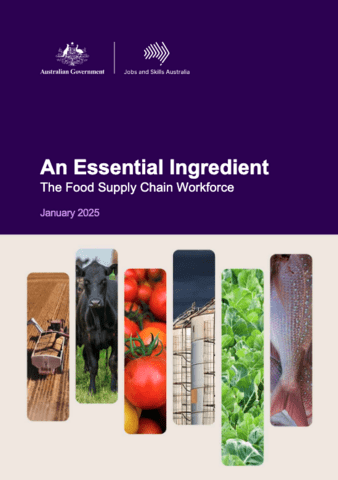
An essential ingredient: the food supply chain workforce
Publisher
Workforce planning
Skilled workforce
Working conditions
Food production
Food industry and trade
Labour force productivity
Supply chain
Vocational education and training
Australia
Resources
| Attachment | Size |
|---|---|
 An essential ingredient: the food supply chain workforce An essential ingredient: the food supply chain workforce
|
18.05 MB |
|
An essential ingredient: summary report
|
14.84 MB |
Description
The report provides a comprehensive view of the challenges faced by the food supply chain workforce (in the production, manufacturing and distribution of food) who play a crucial role in Australia’s economy. It focuses on the key challenges and opportunities that can be addressed through the national skills system – particularly the three key pillars of vocational education and training, higher education and migration. It presents a series of actionable recommendations on key themes, outlining the practical steps that can be taken to improve outcomes for employers, workers and the broader community.
The independent report supports the food supply chain workforce by:
- making 41 recommendations that target the Australian Government’s role in workforce planning, including through the tripartite Jobs and Skills Councils
- providing new insights, analysis and data to support the activities led by businesses, unions, education and training providers, and state and territory governments
- developing the foundations for a shared vision for the food supply chain that unites all parties through common interests, offering opportunities for collective advocacy and action.
Key recommendations
- Improve the relevance and delivery of tertiary education and training.
- Invest in sustainable veterinary and biosecurity workforce pathways.
- Combat worker exploitation and ensure migration continues to support regional Australia.
- Harness opportunities within the Pacific Australia Labour Mobility (PALM) scheme.
- Improve labour hire practices, enforcement and information.
- Support apprenticeships and traineeships for critical roles.
- Facilitate better planning of the food supply chain workforce.
- Address barriers in regional, rural and remote Australia.
Publication Details
Copyright:
Commonwealth of Australia 2025
License type:
CC BY
Access Rights Type:
open
Post date:
23 Jan 2025
