

Journal article
 SHARE
SHARE
Trends in retention and attrition in nine regulated health professions in Australia
Sunita Bayyavarapu Bapuji, Sarah Anderson, Eva Saar
Journal
Employee retention
Skilled workforce
Working conditions
Job stress
Job satisfaction
Registration
Sector regulation
Allied health
Health practitioners
Australia
Resources
| Attachment | Size |
|---|---|
 Trends in retention and attrition in nine regulated health professions in Australia Trends in retention and attrition in nine regulated health professions in Australia
|
561.49 KB |
Description
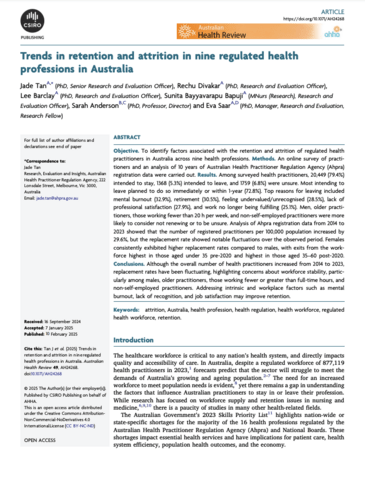
This study finds that while the overall number of health practitioners has increased, replacement rates fluctuate, and certain groups (such as males and older practitioners) are more likely to leave. It highlights mental burnout, lack of recognition, and low job satisfaction as key drivers for practitioners leaving or being unsure about staying in their profession.
The research surveyed 25,752 health practitioners and analysed 10 years of registration data across the Chinese medicine, chiropractic, dental, medical radiation practice, occupational therapy, optometry, osteopathy, paramedicine, and podiatry professions.
Key findings
- Of those surveyed, 79% of health practitioners intended to stay, 5% intended to leave, and 6.8% were unsure.
- The top reasons for leaving included mental burnout (33%), retirement (30%), feeling undervalued/unrecognised (28%), lack of professional satisfaction (28%), and work no longer being fulfilling (25%).
- Male practitioners were nearly twice as likely to leave compared to female practitioners.
- Practitioners working fewer than 20 hours per week were nearly twice as likely to leave or be unsure compared to those working 29-40 hours.
- Non-self-employed practitioners were nearly twice as likely to be unsure about staying in their profession compared with self-employed practitioners.
- The number of registered practitioners per 100,000 population increased by 30% from 2014 to 2023, but the replacement rate showed notable fluctuations.
Publication Details
DOI:
10.1071/AH24268
Copyright:
The author(s) (or their employer(s)) 2025
License type:
CC BY-NC-ND
Access Rights Type:
open
Volume:
49
Issue:
AH24268
Post date:
13 Feb 2025
