

 SHARE
SHARE
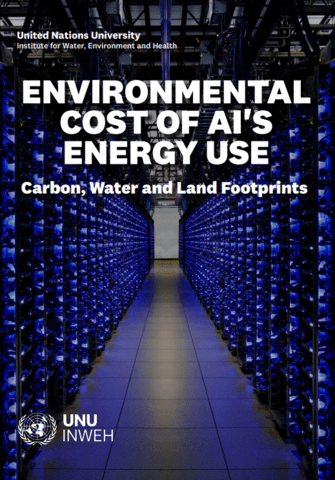
Environmental cost of artificial intelligence: carbon, water and land footprints

This report examines one of the most underexplored consequences of artificial intelligence's (AI’s) rapid expansion: the environmental footprints of the energy required to power it. The report shows that AI is not only a digital technology, but also a material system with measurable environmental costs.
The report moves beyond a carbon-only lens by quantifying the carbon, water and land footprints associated with the electricity used to train, deploy and operate AI systems at scale. Its central finding is that AI’s environmental costs depend not only on how much electricity is used, but also on where that electricity is generated and which energy sources power it.
The report frames AI’s environmental footprint as a governance and justice challenge, not only a technical problem. The benefits of AI often flow across borders and sectors, while the environmental burdens of data centre siting, electricity demand, water withdrawals, land use, mineral extraction and e-waste can be concentrated in specific communities and regions. To address these risks, the report calls for a responsible AI ecosystem grounded in transparency, efficiency by design, equity and environmental justice, lifecycle responsibility, global cooperation and sustainable use.
By making AI’s carbon, water, and land footprints visible and comparable, the report provides a practical basis for integrating AI into energy, climate, water, and land-use planning, ensuring that innovation advances without shifting environmental costs onto vulnerable communities.
