

Organisation
National Centre for Vocational Education Research (NCVER)
Acronym:
NCVER
Website:
Research Summary
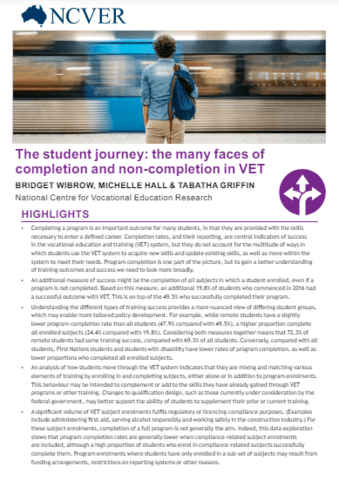
The student journey: the many faces of completion and non-completion in VET
This research summary explores the many faces of course completion and non-completion and identifies instances where some non-completions can be considered to be successful outcomes of VET. In a sense, this approach, which uses student enrolment data, broadens the parameters for measuring success.

Report
The impact of increasing university participation on the characteristics of apprentices
During the last decade undergraduate university enrolments have grown considerably. To explore whether young people who would have previously chosen an apprenticeship have instead entered university, this analysis uses data from the Longitudinal Surveys of Youth (LSAY) to compare the characteristics of apprenticeship-bound with university-bound young people and to look at if they have changed...

Report
VET student outcomes – top 100 courses (2023)
The analysis of the VET National Data Asset (VNDA) provides valuable insights into student outcomes achieved through completion of a VET program of study. This analysis covers the top 100 course completions in the 2018-19 financial year, representing 66.5% of all VET course completions.
Research Summary
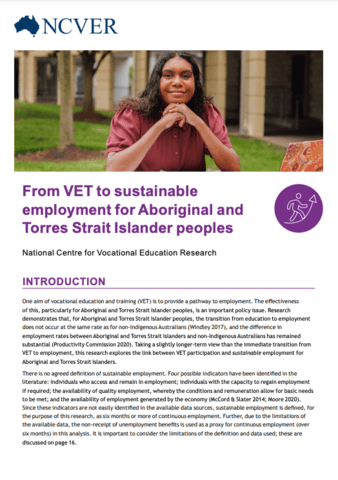
From VET to sustainable employment for Aboriginal and Torres Strait Islander peoples
This research summary from the National Centre for Vocational Education Research finds that vocational education and training (VET) increases chances of achieving sustainable employment for Aboriginal and Torres Strait Islander people.

Report
Building effective RTO–employer partnerships
Effective partnerships between registered training organisations (RTOs) and employers are important in ensuring a robust vocational education and training (VET) sector. This project investigated the drivers for RTO—employer partnerships and the benefits and the challenges related to building and sustaining partnerships, along with strategies that foster the development of quality RTO—employer partnerships.