

Discussion paper
Long-term unemployment and work deprived individuals: issues and policies
A. M. Dockery and Beth Webster write that the incidence of very long term unemployment has risen by nearly 1 percent per annum every year since the late 1970s. Their analysis identifies five different clusters of work deprived individuals. Policy suggestions include more targetted assistance for these clusters and enduring job creation programs, combined with...
Report
An Empirical Analysis of the Effect of Growth on Inflation, Australia, Canada and the United States
Mardi Dungey and John Pitchford argue economists often tend to comment that inflation will tend to increase (or decrease) if growth is higher or lower than the "potential" growth rate of the economy. After setting out a theoretical justification for such a statement, the authors estimate equations relating the change in inflation to growth rates...
Report
Gender, comparative advantage and labour market activity in immigrant families
The family investment hypothesis predicts that credit constrained immigrant families adopt a household strategy for financing post-migration human capital investment in which the partner with labour market comparative advantages engages in investment activities and the other partner engages in labour market activities which finance current consumption. In this paper Deborah Cobb-Clark and Tom Crossley investigate...
Discussion paper
Human capital accumulation: education and immigration
This paper examines the role of human resource development as a driver of growth for Australia. The focus is upon education and immigration as sources of human capital formation and upon associated policies for economic growth.
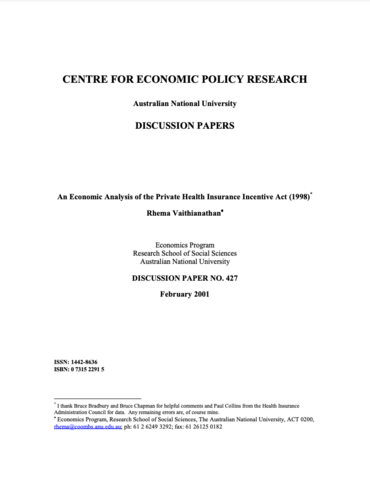
Discussion paper
An Economic Analysis of the Private Health Insurance Incentive Act (1998)
This paper by Rhema Vaithianathan argues that since insurers are able to design plans to separate risk groups, the consequences of adverse selection - one of the bases for the introduction of the Private Health Insurance Incentive Act (1998) - may have been exaggerated.