

Journal article
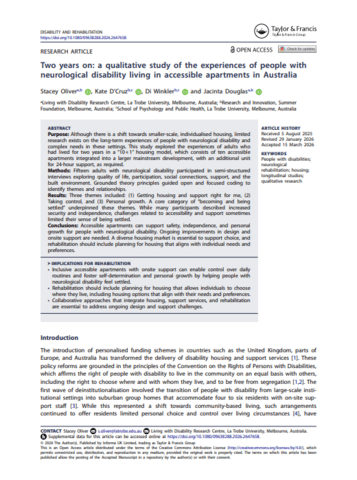
Two years on: a qualitative study of the experiences of people with neurological disability living in accessible apartments in Australia
Although there is a shift towards smaller-scale, individualised housing, limited research exists on the long-term experiences of people with neurological disability and complex needs in these settings. This study explored the experiences of adults who had lived for two years in accessible apartments integrated into a larger mainstream development, with an additional unit for 24-hour...
Journal article
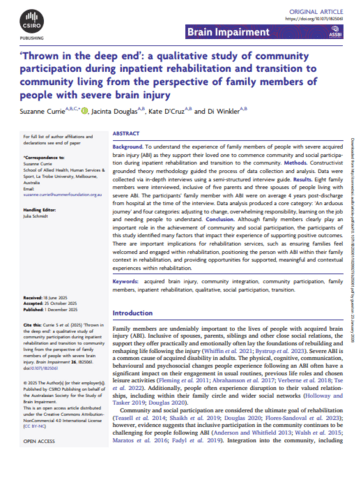
‘Thrown in the deep end’: a qualitative study of community participation during inpatient rehabilitation and transition to community living from the perspective of family members of people with severe brain injury
Family members are undeniably important to the lives of people with acquired brain injury (ABI). This study sought to understand the experience of family members of people with severe ABI, based in Australia, as they support their loved one to commence community and social participation during inpatient rehabilitation and transition to the community.
Journal article
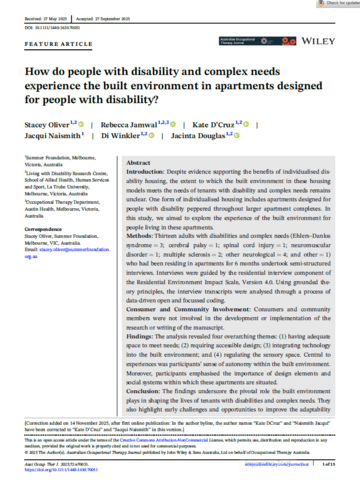
How do people with disability and complex needs experience the built environment in apartments designed for people with disability?
This study examines how apartments designed for people with disability and complex needs support daily life. It identifies four key design factors – space, accessibility, usable technology and sensory management – and finds that good design strengthens independence. Residents also emphasise the need for clearer pre‑move information, better integrated technology and strong support to help...

Journal article
Evaluating the feasibility of the participant-led video intervention to train support workers from the perspective of disability sector professionals
This study evaluates participant‑led videos (PLVs) as a co‑designed tool to improve disability support quality. After a one‑day training workshop, sector professionals confidently produce PLVs with participants. Findings show PLVs centre participant voice, reduce misrepresentation, support autonomy and offer a feasible, scalable approach warranting further investment and outcome research.
Journal article
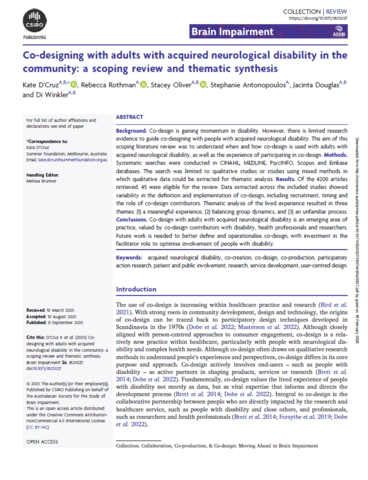
Co-designing with adults with acquired neurological disability in the community: a scoping review and thematic synthesis
This scoping review examines how and when co‑design is used with adults with acquired neurological disability and their lived experience. It finds co‑design remains under‑researched and underutilised, yet is meaningful, supporting participation, connection, belonging and learning. Future work should better define co‑design and invest in facilitation roles.