

Economic indicators
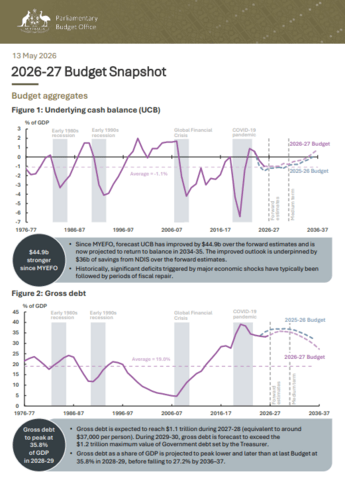
Infographic
2026–27 Budget snapshot
This publication provides a graphical summary of information contained in the Australian Government's 2026–27 Budget. It covers trends in the budget aggregates; programs and measures; expenses and revenue; and key terms and notes. Of the 137 measures in the 2026–27 Budget, the largest 10 measures improve the underlying cash balance by around $10.9b.
Report
State economic scorecard 2026
The scorecard assesses and ranks the performance of each Australian state across ten economic indicators: annual growth in per capita gross state product, annual wage growth, jobs growth, retail turnover, tax burden, debt burden, productivity growth, business investment, rental affordability and energy affordability. Western Australia is the best performing state and New South Wales the...
Report
Decline: a snapshot of the Australian economy in the 2020’s
This research report uses key economic indicators to compare Australia’s economic conditions in the post-pandemic years against previous decades. It finds that Australia is increasingly dependent on government spending and population growth to fuel headline economic growth. Private investment and net export has declined since 2000.
Briefing paper
Inflation remains unaffected by minimum wages
This analysis reveals that a fair and appropriate increase to the minimum wage, and accompanying increases to award rates, would not have a significant effect on inflation in Australia. The analysis examines the correlation between minimum wage increases and inflation going back 30 years, and finds no consistent link between minimum wage increases and inflation.
Report
Hours, not dollars: rethinking the cost-of-living debate
This paper proposes that public debate about the cost of living is based on a misunderstanding of how living standards should be measured. The paper contrasts movements in consumer prices with movements in wages. It identifies sectors where affordability has deteriorated in wage-adjusted terms, arguing that these outcomes are not arbitrary.