

Policy analysis
Alternative labels
Policy advice
Report
Policy responses to rising Autism diagnoses in childhood
Autism Spectrum Disorder (ASD) diagnoses among children and young people have risen two to fourfold across OECD countries, largely due to improved detection. While this increases demand for disability and health supports, it can improve outcomes. The report finds wide variation in supports and a shift towards basing entitlement for support on the needs of...
Briefing paper
When oil shocks return: what the US-Iran crisis means for Australia
A sharp escalation in tensions between the United States and Iran has pushed oil prices higher. This policy briefing examines how the current shock compares to previous oil supply disruptions, and how this price shock can spread through Australia’s economy. It also provides early policy actions Australia can take to stabilise fuel supply and support...
Report
The cost of comparison: when the benchmark becomes the barrier
Australia’s Health Technology Assessment system uses comparative evaluation to determine the value of medicines against a relevant comparator. Comparator selection has increasingly defaulted to the lowest cost comparator. This analysis finds that the lowest cost comparator use has become systemic, creating structural barriers to patient access. It provides a phased roadmap proposing eight actions.
Report
Raising Queensland: child and youth policy priorities
This report considers state government policy in Queensland focused on families and children over time. The report shows Queensland’s children are worse off than other states and that families are often not considered when efforts are made to support kids.
Report
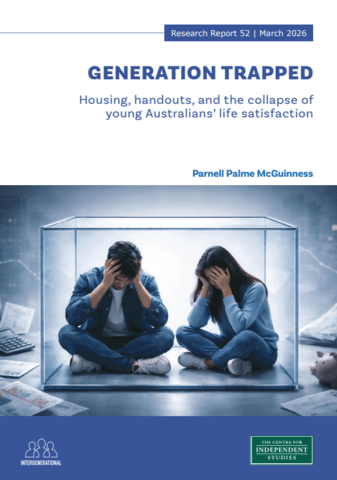
Generation trapped: housing, handouts, and the collapse of young Australians’ life satisfaction
Life satisfaction is trending down for young people in Australia and the West. This paper examines the lives, aspirations, values and perceived barriers of Australians aged 18–34. It creates a foundation for evaluating existing policy and developing new policy to support the priorities and goals of these young Australians.