

 SHARE
SHARE
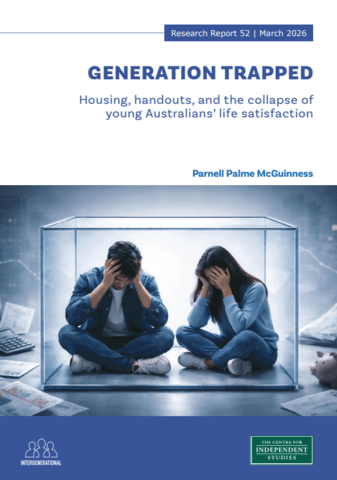
Generation trapped: housing, handouts, and the collapse of young Australians’ life satisfaction

Life satisfaction is trending down for young people in Australia and the West. Those born after 1997 are reporting the highest levels of misery of any age group. This paper examines the lives, aspirations, values and perceived barriers of Australians aged 18–34 – a group which is often treated in policymaking as a homogenous whole. It creates a foundation for evaluating existing policy and developing new policy to support the priorities and goals of these young Australians.
The paper explores levels of life satisfaction, incorporating autonomy (the ability to pursue your own goals), agency (the ability to influence the world around you), self-determination (the ability to choose your path in life), empowerment (the ability to act on self-determination) and self-realisation (the fulfilment of individual potential).
The paper identifies six ‘tribes’, categorised according to their core beliefs, attitudes and life circumstances. This segmentation allows a deeper understanding of each tribe, while comparisons between the tribes reveal insights into the drivers of low life-satisfaction across the age group.
Key findings
- Young Australians want the same things as previous generations – financial security, home ownership, meaningful work, relationships and children – but these goals now feel out of reach.
- Life satisfaction among 18–34-year-olds is lower than for older Australians, driven by higher anxiety and a lack of perceived control over the barriers to achieving their aspirations.
- A loss of personal agency is central to youth malaise: fewer than four in ten young Australians believe they can influence the barriers blocking their aspirations.
- Housing affordability is the single most important perceived barrier across all groups and a powerful symbol of lost control over life outcomes.
- Government handouts that narrow choice or reinforce dependency may fail to improve – and may even worsen – overall life satisfaction.
- Policies that substitute government support for personal choice risk worsening wellbeing. Expanding real choice and agency is more effective than increasing handouts.
