

Affordable housing
Briefing paper
Tackling the affordability gap through increased supply of affordable and social housing
The housing affordability crisis across OECD countries reflects a persistent mismatch between supply and demand. Expanding affordable and social rental housing is central to addressing these challenges. This brief proposes that policymakers can act along two complementary tracks to ease short-term pressures while laying the groundwork for a more inclusive housing market over the long...
Report
2026 State of the nation
The report measures how Australia is advancing across six goals spanning a strong economy and a strong social compact to deliver prosperity for all Australians. The central conclusion is direct, long-term prosperity depends on two pillars working together: a strong economy and a strong social compact. It finds that Australia is not moving fast enough.
Report
Closing the gender gap in housing
Women and gender minority people often face disproportionate barriers to housing security across all life stages. This report outlines the findings and recommendations from a cross-sectoral consultation process. It presents a practical roadmap for embedding a gender lens in housing investment, policy and program decisions across Australia.
Strategy
Homes for Australia: a national plan
The federal government’s comprehensive $47 billion plan to rebuild Australia’s housing system. It identifies policy levers at the Commonwealth, state and territory, and local government levels. The plan sets out six priorities for further reform and directs future housing and homelessness investment.
Briefing paper
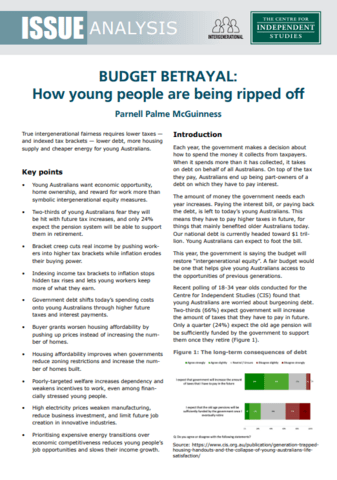
Budget betrayal: how young people are getting ripped off
This year, the Australian Government is saying the budget will restore 'intergenerational equity'. This analysis argues that policies presented as promoting ‘intergenerational equity’ are failing to address the structural drivers of inequality. It presents recent polling indicating that young Australians are worried about burgeoning public debt. The paper proposes alternative policies to deliver intergenerational fairness.