

 SHARE
SHARE
Tackling the affordability gap through increased supply of affordable and social housing
| Attachment | Size |
|---|---|
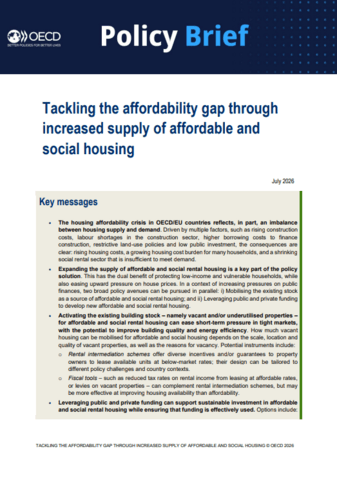
 Tackling the affordability gap through increased supply of affordable and social housing Tackling the affordability gap through increased supply of affordable and social housing
|
399 KB |
The housing affordability crisis across OECD countries reflects a persistent mismatch between supply and demand, driven by structural constraints on housing provision and insufficient public investment in affordable and social housing. This imbalance has pushed up housing costs, increased financial pressure on households and reduced labour mobility and access to employment, with adverse effects on well-being and economic performance.
Expanding affordable and social rental housing is central to addressing these challenges. Strengthening specialised housing providers and ensuring viable business models for affordable and social housing providers are key to delivering and managing quality affordable housing over the long term. Policymakers can act along two complementary tracks to ease short-term pressures while laying the groundwork for a more inclusive housing market over the long term.
- First, governments can consider tools to assess and activate viable existing stock (including vacant and underutilised dwellings) through rental intermediation schemes and fiscal incentives to encourage property owners to lease dwellings at affordable rates.
- Second, governments can leverage public and private funding to support sustainable investment in affordable and social rental housing. This includes establishing special-purpose funding instruments, aligning rent-setting with both affordability and cost recovery, and regularly assessing housing needs to sustain investment over time.
