

Artificial Intelligence (AI)
Alternative labels
Generative AI (GenAI)
Guide
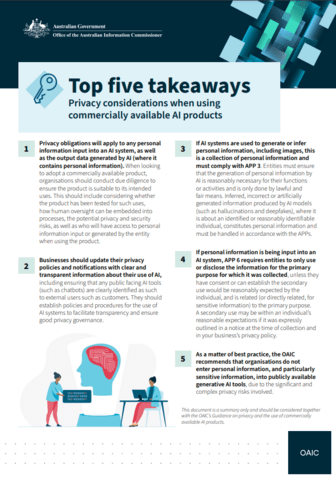
Guidance on privacy and the use of commercially available AI products
This guidance is intended to assist organisations to comply with their privacy obligations when using commercially and freely available AI products, in particular generative and general-purpose AI tools. Overall, it is recommended organisations do not enter personal information into publicly available generative AI tools due to the significant and complex privacy risks involved.
Guide
The AI Impact Navigator
A framework for companies to assess and measure the impact and outcomes of AI use. It is intended to help companies and their leaders demonstrate accountability for the impact of AI, increase transparency and build public trust.
Discussion paper
Review of AI and the Australian Consumer Law
AI is a fast-evolving class of technologies. AI may impact a range of economic activities and boost productivity growth. This discussion paper seeks views on whether the Australian Consumer Law (ACL) remains suitable to: protect consumers who use Artificial Intelligence (AI); support the safe and responsible use of AI by businesses.
Report
Synthetic content: exploring the risks, technical approaches, and regulatory responses
This report analyses the various approaches being pursued to address the risks associated with “synthetic” content – material produced by generative artificial intelligence (AI) tools. As more people use generative AI to create synthetic content, civil society, media, and lawmakers are paying greater attention to some of the risks—such as disinformation, fraud, and abuse.
Discussion paper
Governance in the age of generative AI
This report equips policymakers and regulators with implementable strategies for resilient generative AI governance contained within a 360-degree governance framework. The pillars of the comprehensive framework address regulatory gaps, stakeholder-specific governance challenges and the evolving demands of this rapidly advancing technology.