

Welfare recipients
Briefing paper
(Cth) Increase the Disability Support Pension payment to above the poverty line
This briefing paper argues the costs of disability are not sufficiently reflected in the rate of the Disability Support Pension. It notes that people with disability often incur additional costs as a result of their disability, have reduced work opportunities and can become trapped in a cycle of poverty and poor health.

Report
Rental affordability snapshot: national report 2026
The snapshot tracks Australia’s private rental market, surveying around 49,000 rental listings nationwide. It measures whether Australians on low incomes can afford to rent a home on the private market. This year's snapshot shows people on the lowest incomes have no access to the private rental market.
Report
Work, welfare and wellbeing around entry into the NDIS
The National Disability Insurance Scheme (NDIS) is one of Australia’s largest social programs, yet questions remain about how it affects participants’ employment, reliance on other welfare payments, and overall wellbeing. Understanding these relationships is essential for assessing the scheme’s long-term sustainability and its role in supporting participation and independence.
Report
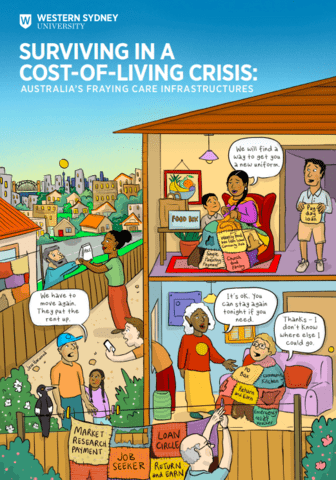
Surviving in a cost-of-living crisis: Australia's fraying care infrastructures
This report examines how Australia's care infrastructures, encompassing welfare, housing, food and community support systems are fraying and increasingly failing to meet the basic needs of those on low- or no- income. The report documents the labour-intensive and precarious work required to piece together fragmented supports amid a worsening cost-of-living crisis.
Briefing paper
Welfare for the well off? The progressivity of government transfers by income and wealth
Policy and demographics are changing the character of Australia’s social safety net. Cash transfers like JobSeeker and Family Tax Benefit are shrinking. Meanwhile, ‘in-kind’ transfers like government-subsidised education, disability and health care are increasing quickly. This paper uses survey microdata to detail how rising in-kind transfers are changing who receives government support.