

Briefing paper
 SHARE
SHARE
Welfare for the well off? The progressivity of government transfers by income and wealth
Publisher
Tax-and-transfer system
Welfare state
Welfare recipients
Means tests
Wealth
Australia

Description
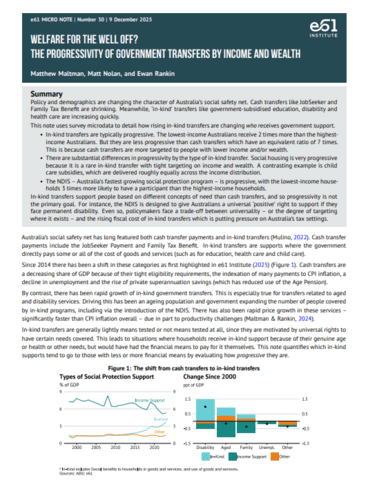
Policy and demographics are changing the character of Australia’s social safety net. Cash transfers like JobSeeker and Family Tax Benefit are shrinking. Meanwhile, ‘in-kind’ transfers like government-subsidised education, disability and health care are increasing quickly. This paper uses survey microdata to detail how rising in-kind transfers are changing who receives government support.
Policymakers face a trade-off between universality – or the degree of targeting where it exists – and the rising fiscal cost of in-kind transfers which is putting pressure on Australia’s tax settings.
Key findings
- In-kind transfers are typically progressive. The lowest-income Australians receive 2 times more than the highest income Australians. But they are less progressive than cash transfers which have an equivalent ratio of 7 times.
- There are substantial differences in progressivity by the type of in-kind transfer. Social housing is very progressive because it is a rare in-kind transfer with tight targeting on income and wealth. A contrasting example is child care subsidies, which are delivered roughly equally across the income distribution.
- The National Disability Insurance Scheme (NDIS) – Australia’s fastest growing social protection program – is progressive, with the lowest-income households 3 times more likely to have a participant than the highest-income households.
Publication Details
Copyright:
e61 Institute 2025. Reproduced with permission.
License type:
All Rights Reserved
Access Rights Type:
open
Post date:
11 Dec 2025
