

Social media
Alternative labels
Online social networks
Briefing paper
The likely to be accessed test and the Children’s Online Privacy Code
The Children’s Online Privacy Code in Australia will establish a set of guidelines to improve children’s privacy. This policy briefing explores a discussion held by academia and civil society in July 2025 around how the ‘likely to be accessed’ (LTBA) standard might be operationalised in the Code.
Report
A baseline for online safety transparency
In 2024, the Office of the eSafety Commissioner gave their first periodic notices on child sexual exploitation and abuse material and activity (CSEA) to eight online service providers: Apple, Discord, Google, Meta, Microsoft, Skype, Snap and WhatsApp. This report contains a summary of each of the providers' responses and shines a light on online industry...
Briefing paper
Community disorder: how do we prevent an information emergency?
One year on from the United Kingdom Southport riots – fuelled by social media – this briefing includes policy recommendations for information critical incidents in both election and non-election contexts. It outlines key findings and sets out recommendations for government, the communications regulator and social media platforms, aimed at strengthening the performance of content moderation...
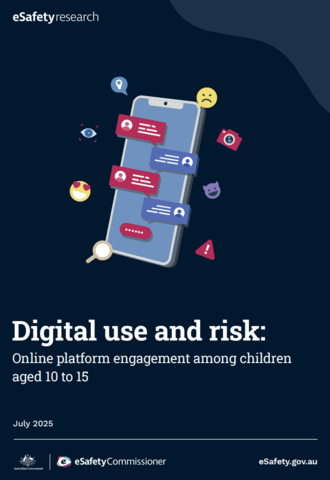
Report
Digital use and risk: online platform engagement among children aged 10 to 15
Online platforms are a central part of life for children in Australia. As children increasingly navigate digital spaces, it is essential to understand not only how they use these platforms but also the risks they may encounter. This short report details top-line findings on the use of online platforms and experiences of harms among 10–15-year-olds.
Report
The legal and policy landscape of age assurance online for child safety and well-being
This report maps the current legal and policy landscape for age assurance. It analyses laws that establish age-dependent protections or obligations and therefore trigger a need to assure age. This work aims to support government and industry action for promoting the opportunities offered by digital technologies for children while keeping them safe from potential harms.