

Democratic reform
Report
Mode shifting: Whitehall reform that liberates public services to shift between transactional and relational delivery modes
This report considers reforms needed to build a state that is more responsive to the diversity of citizens’ needs and the barriers that are hampering reform at scale in the United Kingdom government. It makes the case for reform to enable the government to “mode shift” and work in different ways to achieve different outcomes.
Report
Inquiry into the conduct of the 2025 federal election: interim report
An interim report into all aspects of the conduct of the 2025 federal election and related matters, with attention to: the review of the purported increase in incidents of aggressive conduct, deliberate obstruction and intimidating behaviour; and the suitability and potential reform of measures to ensure universal voter access. The report provides 14 recommendations.
Report
Reimagining lawmaking: how to build trust in parliament
Political trust is essential to a well-functioning democracy, but it has declined sharply in the United Kingdom over recent decades. To democratise law-making and rebuild political trust – this report makes the case for action in three key areas: rebuilding trust in lawmakers; rebuilding trust in law-making institutions; and extending the role of citizens in...
Report
For the people: future-proofing Australia’s democracy
Australia is one of the world’s leading democracies, but cannot take it for granted. This report shows that democracy is backsliding globally, and the world order in which Australia has flourished is being seriously tested. The report identifies five priorities for Australia to build a better and more resilient democracy.
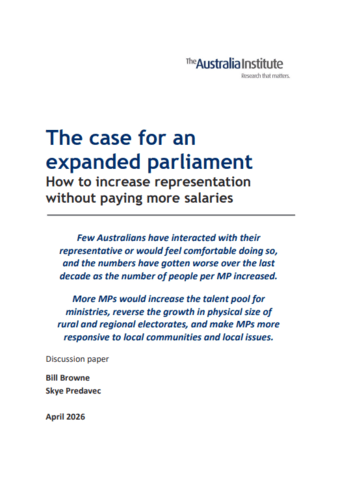
Discussion paper
The case for an expanded parliament
Australia’s democracy is being stretched thin, with each federal parliamentarian MP now representing almost four times as many people as at Federation. This paper proposes that more MPs would increase the talent pool for ministries, reverse the growth in physical size of rural and regional electorates, and make MPs more responsive to local communities.