

Financial security
Alternative labels
Financial independence
Briefing paper
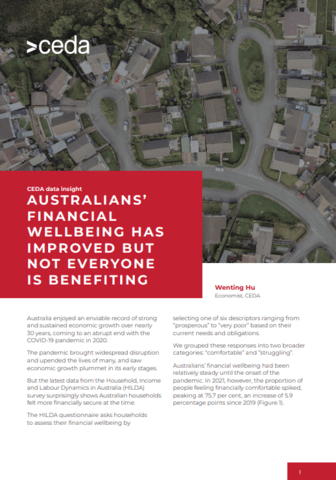
Australians’ financial wellbeing has improved but not everyone is benefiting
The paper groups financial wellbeing responses into two broad categories: 'comfortable' and 'struggling', focusing on the role of housing. It finds that younger Australians have been hit particularly hard, with multiple sources of financial difficulty. The paper proposes that without targeted policy intervention, financial security becomes increasingly dependent on home ownership status and inherited generational...
Report
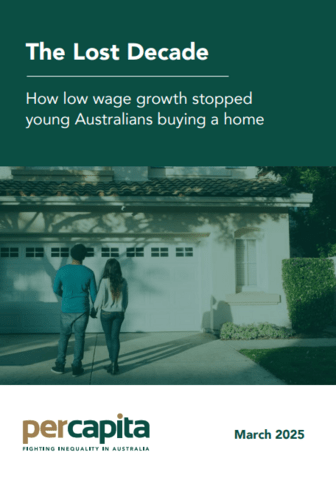
The lost decade: how low wage growth stopped young Australians buying a home
This report examines the impact of the decade 2012 to 2022, during which real wages barely grew, exploring how this has affected young Australians. $600b in wages were lost to profit over the decade but wage growth has since recovered and dwelling prices have moderated, reducing pressure on housing affordability.
Evaluation
Evaluation of the Escaping Violence Payment place-based trial
This evaluation is of the place-based trial of the Escaping Family Violence Payment in Far North Queensland and the Torres Strait. It found the payment was highly effective in supporting people leaving violent relationships and the place-based trial demonstrated the practice and benefits of culturally appropriate service delivery.
Survey Report
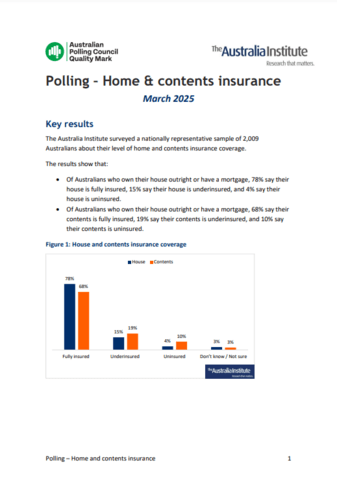
Polling: home and contents insurance
The paper presents results from a survey of a nationally representative sample of 2,009 Australians about their level of home and contents insurance coverage. Almost one in five Australians admit their home is uninsured or underinsured, representing around 1.4 million homes at risk at a time of increasing natural disasters.

Briefing paper
Cost of living crisis relief: insights from the COVID-19 financial support policies
This paper examines how two major policies responding to the COVID-19 pandemic affected the wellbeing of eligible recipients, one that increased liquidity by releasing personal savings and one that increased wealth through a government transfer. The findings suggest the former raised life satisfaction while the latter did not.