

Regulatory burden
Alternative labels
Regulatory compliance cost
Report
The Safeguard Mechanism: Australia’s self-imposed ‘Trump tariff’
The Safeguard Mechanism is the federal government’s net zero policy which targets and mandates large projects and facilities to reduce emissions. This paper finds that the carbon credit cost under the Safeguard Mechanism represents a more significant risk to Australia’s exporters than the tariffs imposed by the United States Trump Administration.
Report
Reforming Australia’s system of business taxation
This report contributes to debates over tax reform by examining the system of business taxation in Australia. It identifies five challenges, illustrating that the problems with Australia’s system of business taxes are complex and multifaceted. The report presents five reform steps which would deliver a simpler, lower and more productive system.
Briefing paper
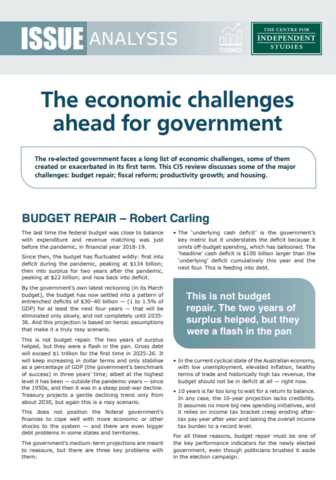
The economic challenges ahead for government
This paper discusses some of the major economic challenges facing the re-elected Australian Government: budget repair, fiscal reform, productivity growth and housing. It finds that many of the government's fiscal and policy problems are unlikely to resolve without decisive reform. The paper argues that the government must now take fiscal discipline, productivity growth and housing...

Report
Size matters: why construction productivity is so weak
The construction industry is vital to Australia's productivity. However, this report identifies a range of contributing factors to its underperformance, including tax settings, regulation, lack of technology adoption, lack of innovation, unpredictable pipelines of work, poor collaboration, a fragmented sector and small firm size. It calls for policies to lift productivity in construction.
Report
Housing construction productivity: can we fix it?
An examination of productivity growth in the housing construction sector, highlighting decades of poor performance. The paper provides policy directions for improving construction productivity by reducing regulatory burden, streamlining and speeding up approval processes, supporting innovation and improving workforce flexibility. It provides seven reform directions to improve homebuilding efficiency.