

Briefing paper
Briefing paper
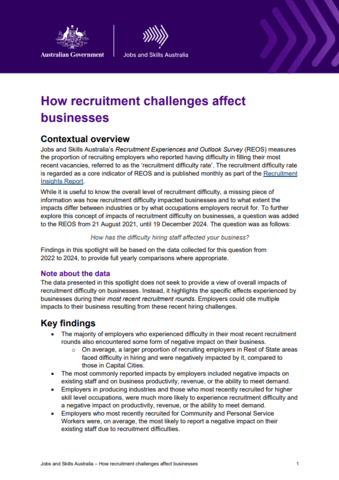
How recruitment challenges affect businesses
This paper examines the proportion of recruiting employers who reported having difficulty in filling their most recent vacancies, referred to as the ‘recruitment difficulty rate’, and how it affects business performance. Employers who most recently recruited for community and personal service workers were, on average, the most likely to report a negative impact on their...
Briefing paper
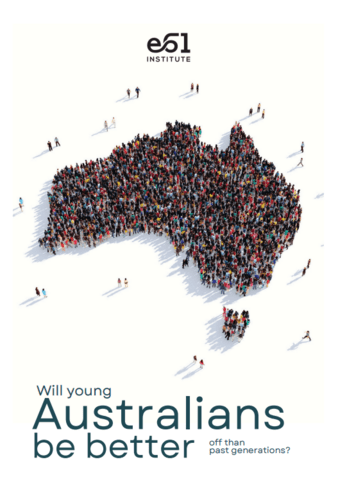
Will young Australians be better off than past generations?
This report highlights how today’s young Australians differ from previous generations and explores what this means for their economic security, work opportunities, living arrangements, path to independence and overall wellbeing. For policymakers seeking to seeking to ensure that an intergenerational pattern of improvement continues, this report offers three implications.
Briefing paper
Incoming government brief: psychosocial disability & the National Disability Insurance Scheme
This brief outlines practical policy solutions to deliver a tailored approach to improve outcomes for participants with psychosocial disability with existing funding. It recommends priority actions informed by sector and lived experience expertise which, if implemented, would improve the efficacy of funding already committed to the NDIS.
Briefing paper
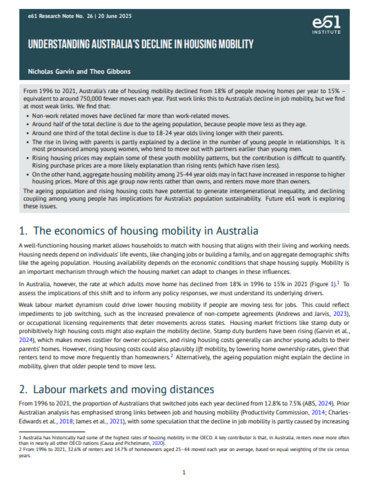
Understanding Australia's decline in housing mobility
From 1996 to 2021, Australia’s rate of housing mobility declined from 18% to 15%. This paper assesses the implications of this shift and outlines the underlying drivers. Past work links this to Australia’s decline in job mobility, but this paper finds at most weak links. The findings challenge a number of common narratives.
Briefing paper
Policy alignment for place-based solutions for better health outcomes in rural and remote communities
Rural and remote communities in Australia continue to face entrenched barriers to accessing timely, person-centred care. This paper calls for national leadership to shift from siloed, input-focused service models to coordinated, outcome-driven approaches. It identifies four key areas for reform to support policy alignment for place-based health solutions.