

Australia
Report
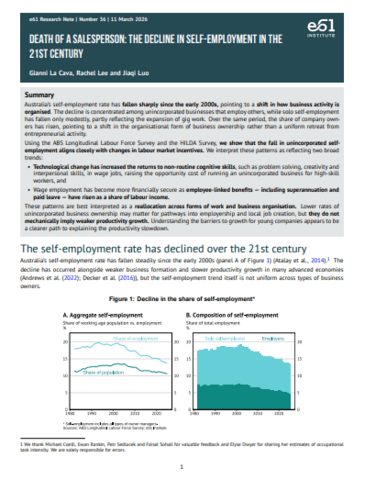
Death of a salesperson: the decline in self-employment in the 21st century
Australia’s self-employment rate has fallen sharply since the early 2000s. This report shows a fall in unincorporated self-employment aligns closely with changing labour market incentives. Unincorporated businesses that employ workers experienced the greatest decline, while solo self-employment fell modestly and the share of company owners grew. The patterns are interpreted as reflecting two broad trends.
Briefing paper
Australia and the upending of US intelligence
This explainer assesses how the Trump Administration’s approach to United States intelligence is affecting, and will affect in the future, Australia’s national intelligence community and by extension its national interests. It concludes that Australia should enhance the fields in which it has, or can develop, genuine sovereign intelligence capabilities and thinking.
Briefing paper
Responsible + respectful sharing: children’s data and social media use in education
The paper presents a collective stance from researchers and industry bodies on the responsible and respectful use of children’s digital data in social media and online communications within education settings in Australia. It outlines five principles to advocate for a shared understanding of the key issues regarding the sharing of children’s data on social media.
Report
Pseudolaw and sovereign citizens
This paper examines pseudolaw and its most prominent adherents, sovereign citizens. It outlines pseudolaw and its origins, sets out common arguments and beliefs, and explores factors for its spread in New South Wales and Australia. While the scale of the phenomenon is difficult to precisely identify, the paper discusses its impacts and ways to respond.
Report
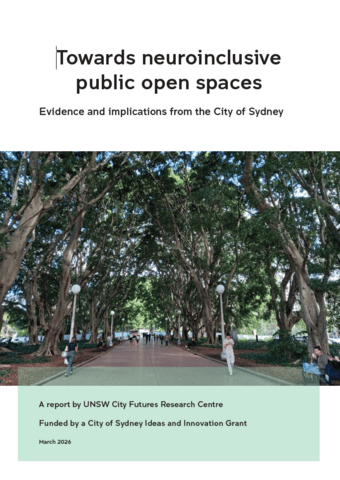
Towards neuroinclusive public open spaces: evidence and implications from the City of Sydney
This report examines how neurodivergent adults experience Sydney’s public open spaces and identifies environmental factors that shape participation. Drawing on lived‑experience insights, it highlights how sensory load, predictability, legibility and supportive amenities influence comfort and inclusion. The findings provide practical guidance for strengthening urban policy, planning and design.