

Report
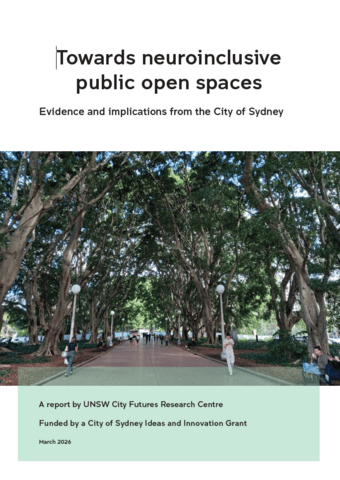
Report
Towards neuroinclusive public open spaces: evidence and implications from the City of Sydney
This report examines how neurodivergent adults experience Sydney’s public open spaces and identifies environmental factors that shape participation. Drawing on lived‑experience insights, it highlights how sensory load, predictability, legibility and supportive amenities influence comfort and inclusion. The findings provide practical guidance for strengthening urban policy, planning and design.
Report
Pseudolaw and sovereign citizens
This paper examines pseudolaw and its most prominent adherents, sovereign citizens. It outlines pseudolaw and its origins, sets out common arguments and beliefs, and explores factors for its spread in New South Wales and Australia. While the scale of the phenomenon is difficult to precisely identify, the paper discusses its impacts and ways to respond.
Report
Evidence-based pedagogies to support online engagement of low SES, and regional, rural, and remote students
Online learning has increased significantly. Using Tasmanian data, this report outlines how a lack of pedagogical support for students studying online disproportionately impacts on students from disadvantaged backgrounds, including lower course completion rates and a reduced sense of place and belonging. It provides recommendations aimed at teachers, university leaderships and policymakers.
Report
Artificial intelligence, cognitive offloading and implications for education
This report investigates the challenge driven by the rapidly expanding use of artificial intelligence (AI) in schooling: the risk that students will outsource too much of the cognitive work that is crucial to establishing knowledge, skill and ‘thinking infrastructure’. The report includes specific recommendations for policy and teaching and learning strategies.
Report
Independent review of the HELP Debt Reduction Program: final report
The independent review assessed the design, delivery and effectiveness of the HELP debt reduction program for doctors and nurse practitioners in rural, remote or very remote areas, and teachers in very remote areas. The report contains nine recommendations to improve uptake, simplify administration and strengthen the evidence base ahead of the program’s next review.